Showing posts with label amazing science blog. Show all posts

Friday, June 17, 2011

Through the Wormhole Season 2 Episode Guide


One of the best science documentaries these days, Through the Wormhole, has started its 2nd season recently. So let's check out the upcoming episodes to see what the 2nd season is all about.


The 2nd season will feature 10 episodes, which is 2 more than in the 1st season. The episodes will cover a variety questions in various branches of science as usual.

So here are the 10 episodes with corresponding titles:


1"Is There Life After Death?"June 8, 2011
In the premiere episode of the second season, Morgan Freeman dives deep into this provocative question that has mystified humans since the beginning of time. Modern physics and neuroscience are venturing into this once hallowed ground, and radically changing our ideas of life after death. Freeman serves as host to this polarized debate, where scientists and spiritualist attempt to define 'what is consciousness,' while cutting edge quantum mechanics could provide the answer to what happens when we die. 
2"Is There an Edge to the Universe?"June 15, 2011
It is commonly theorized that the universe began with the Big Bang 13.7 billion years ago. But since we can only see as far as light has traveled in that time, we can't actually make out the edge of the universe. Could it be that the universe is infinite? Is there any way to find out what the shape of the universe really is? Can we find the edge, discover what might lie beyond it, and perhaps even discover a universe next to ours? 
3"Is Time an Illusion?"June 22, 2011
It is a question that has vexed philosophers and scientists for centuries; 'What is Time?' Exactly how is our past, present, and future connected by that arrow of cause and effect that we call Time? Is time simply another dimension, just like the dimensions of space we know? Can you run time backwards just as easily as it runs forward, just as left-to-right can swap for right-to-left? If other universes exist, then what is time like in them: could their Time be different from ours? And we'll probe the biggest question about time: Is our future determined? Do we exercise free will? Or, is time merely a dream? 
4"Are There More than Three Dimensions?"June 29, 2011
We move and live in three dimensions: length, width, and height. However, Einstein revealed what was once unimaginable: time is actually a dimension and linked with space itself. To reconcile the massive cosmic and miniscule quantum worlds, physicists are realizing four dimensions may not be enough. They're unraveling up to eleven dimensions. How could this be true? Where could these dimensions be? 
5"Is There a Sixth Sense?"July 6, 2011
Can we perceive objects and events beyond the world detected by our five senses? The true limits of our human brain remain a scientific mystery. New studies in neuroscience are showing that our minds can really detect events and objects that our conscious selves know nothing about. Can we predict events in the future? Is there such a thing as a global consciousness? Could physical laws on the cusp of being discovered be at the root of all this? 
6"Are There Parallel Universes?"July 13, 2011
Imagine you will die tomorrow morning in a horrific car crash. Somewhere far, far away, there's an exact version of you that got in the same car, drove the same route, and collided with the same commuter. But this other version of you survives to drive another day. It may sound like science fiction, but it's looking more and more scientifically likely. Somewhere out there, beyond the cosmic horizon, inside a black hole, or as close as an atom's length away, there could be a parallel universe. If this is the case, how could we ever know? And would we ever be able to pay this universe a visit? 
7"Is There an Equation of Everything? (TBD)"July 20, 2011
It was Einstein's famous unfinished project - to find one law that unites all of physics, and explain everything in the universe. It's still an unfinished project, and today hundreds of physicists from CERN to NASA to the Ivory Towers around the world are struggling to find this holy grail of science. Is there one theory, one equation that governs every single event in our universe? An overarching structure to reality? This episode of THROUGH THE WORMHOLE attempts to journey into an understanding what the universe is made of, and how we got here. 
8"Can We Travel Faster than Light? (TBD)"July 27, 2011
It's called the speed limit of the universe. Einstein blew all of our minds when he worked out the Theory of Relativity, and showed that space and time were malleable substances. He also theorized that we as humans can never travel faster than the speed of light, which leaves the stars and other galaxies almost impossibly out of our reach. But the dreams of Star Wars and Star Trek are not dead. In fact, there could be ways to travel faster than the speed of light - and some of them are already being tested in labs around the world. 
9"Can We Live Forever?"August 3, 2011
Medical advances have doubled human life expectancy in past centuries. But can humans ever beat death altogether? Can we control and fix the errors that build up in our DNA over the years? Can we find a way to replace the chemistry of life with something more durable? This episode wonders into the mystifying definition of 'eternity' as it relates to human lifespan. 
10"What Do Aliens Look Like?"August 10, 2011
Science fiction writers have always had their little green men. But these humanoid aliens were based soundly on Earth-based life, not any extra terrestrial evidence. Today, we've discovered hundreds of planets around other stars. As we learn what some of these alternative Earths might look like, science and imagination have allowed us to use real science to imagine the biology of their inhabitants. Will they have two eyes? Two legs? What color will their skin be? Which species on Earth can give us clues about likely biology of aliens? And what can we learn from how life on Earth developed to help us understand what ET really looks like? 
Source 

As we can see the questions are even more fascinating than in the previous season (with exception to the first episode of course). I especially like the episodes 1, 5, 9 and 10 as they seem rather unique, having in mind that not many documentaries covered these questions.

Other episodes seem to be rather familiar and seen often in other documentaries, but I'm sure that Morgan Freeman, and the team of Through the Wormhole will give these subjects a brand new feel and depth.

If you haven't seen season 1, it can be found here:

Thursday, June 2, 2011

Free Will?


So lately I've been reading this book called Asymmetries in Time by Paul Horwich. It's a book on philosophy of science, mostly grappling the problems regarding the nature of time. I don't really like philosophy of science books, because i find it strange when philosophers grapple such problems as the nature of time by only playing with words and concepts. I truly believe that such a problem as a nature of time can only be solved by scientists.

But anyway, back to my point, I stumbled upon a chapter about a philosophical theory called fatalism. From what I understand this theory states this: since every event that will happen in the future depends on the past events (a chain of past events, which cause the future events) and we cannot change the past, the future is fixed. In other words, everything in our universe is already predetermined. 

But aren't we making random and free decisions everyday? Well it's a hard question. But if you think about it for a while, you can come to conclusion that every event has a cause. That is, every action and even every thought has a cause and is predetermined by the past thoughts and actions. Actually, if a supercomputer of an amazing power would exist, we could calculate and predict our future thoughts and actions, that is, our future seems to be already predetermined.

So the big question is: are we really just simple puppet dolls, which have no free will, as our futures are fixed. Well if it is the case, then it seems scary and unpleasant - after all, everyone wants to rule his life.

The interesting thing is that we can't really determine everything with a perfect precision. That is, due to Heisenberg's uncertainty principle, the microscopic world of smallest particles is ruled only by probabilities. This opens some space for randomness in our universe. Actually some scientists even believe that a random quantum fluctuation could have caused the big bang.

So the important question is as follows: is our universe deterministic or is it random. In either way, it leaves little space to free will, as even if the world is random, we can't control this randomness.

So are we just simple puppet dolls, who have a predetermined destiny, or are we lost in an ocean of randomness? Or maybe all of this is wrong, and there is still place for our free choices in our universe. Nobody knows... And after all, would it be interesting if we knew?

Friday, April 29, 2011

Wonders Of Mathematics - Magic Squares


So one of the books that I really enjoyed recently is the famous Dan Brown's "The Lost Symbol". If you read the book (and you should) you might have noticed that it has many interesting maths references. One of which is hidden in the famous Albrecht Dürer's 1514 engraving Melencolia. It's a very special magic square.

But what are these magic squares? Magic squares are very interesting square arrangements of numbers. The numbers are arranged in such a way, that the sum of all columns, rows and diagonals is equal to the same number.

Magic squares come in different sizes that are called orders, for instance 3x3, 4x4 and so on (it's just a number of rows and columns). As for the sum that is constant for columns, rows and diagonals it's called the magic constant.

 
Image Source

The most simple magic square is of order 3x3 (it's easy to see that 2x2 squares are not possible). But how do you construct such a magic square, without relying to guess work? There are various rules, which can help you construct the square faster, however some guess work is still essential.

So when stumbled across these magic squares, I decide it would be fun to found a 3x3 magic square without any help. It's quite fun, well at least much more fun than sudoku, so I encourage you to try it.

Thanks for reading. Next time we're gonna look at all possible 3x3 magic squares and at the mysterious Melancolia engraving.

Saturday, April 16, 2011

The Great Debate of the Nature of Reality


Edinburgh this week is a very interesting place to be at, due to the famous international science festival. This science festival in short is two weeks of pure fun for science fans. It has everything, starting with talks by famous scientists and writers, events for kids, screenings of Brian Cox's newest film, talk by Richard Dawkins and so much more.


If you have the chance to visit Edinburgh during the festival I highly recommend it. You can find all the needed information at the following link.

But why am talking about this festival? Well, simply I had a chance to visit some great talks. One of them was by Manjit Kumar, a scientist and a philosopher, who is the author of the new book "Quantum - Einstein, Bohr and the Great Debate About the Nature of Reality".


It was a great talk, which involved a lot of historical facts and amazing pictures. Needless to say it involved a lot explanations about the discoveries of quantum mechanics. The most interesting part was about the famous Einstein and Bohr debates regarding the interpretation of quantum mechanics.


So without spoiling the fun I can say that it was a great talk and it's an even greater book, so don't hesitate and buy it as it's really cheap. I especially recommend it for all of you science history lovers.

PS:  the author of the book has a very nice blog, which can be found here.

Also you can buy the book here:


Monday, April 4, 2011

BBC - Everything And Nothing


Here we have another great documentary from the BBC team. This time is literaly about everything and nothing. It's great as all the other BBC documentaries. Enjoy!


Thanks for reading! Be sure to comment and subscribe ;]


You might be interested in:

Sunday, April 3, 2011

Basics of Quantum Mechanics Lesson 4


So last time we calculated the wave function of a free moving particle and got the following answer:

SE for a free moving particle:
Solution for this equation:  

So what do these equations tell us about the free moving particle? To find the answer to this question we need to find the probability density function. If you recall, the probability density function is basically just the square of an absolute value of the wave function. So by calculating the probability density function we would get:


|Psi |^2 = Psi x complex conjugate of Psi =
= A(cos(kx − wt) + i sin(kx − wt))A(cos(kx − wt) − i sin(kx − wt))
= A^2(cos2(kx − wt) + sin2(kx − wt))
= A^2


Now if you look at the result more carefully, you should realise that there's some strange stuff going on. The probability density function is constant, that means that the probability of finding a the particle in any point of space is equal. In more simple words, you have the same probability of finding the free moving particle in your room and somewhere in the other side of the universe. This is due to the fact that we have not taken into account the uncertainty of the momentum of a particle.


So you might be asking  - why are we studying free moving particles, while in reality most of the matter is situated in confined atoms and molecules. And you're definitely right, so let's look at another system, which might help us understand the behaviour of electrons, which are "trapped" in an orbit of an atom.


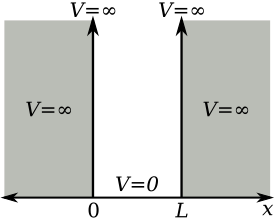
The easiest way of understanding simple atoms or similar systems is using a thing called infinite potential well. That is a system in which a particle is trapped between infinite potential "walls", which can be for instance be various electric of magnetic fields or anything similar, which confines the particle in a given space. After all, in a sense electrons orbiting a nucleus are also in a similar potential well - if they get too close to the nucleus, they are pushed back, if the get too far they are attracted back. 


Infinite potential well:


So how does particle behave in such a well? Well let's firstly imagine what would happen in a classical situation, let's say for a tennis ball trapped between two walls. It's clear that (neglecting gravity, which would eventually bring the ball down) any position between the walls has the same probability of finding the ball there.

However, in quantum mechanics, things are different. We already know that particles tend to behave as probability waves, so it's clear that the probability of finding the particle in any point of space will not be equal( a good analogy of a wave in a sort of potential well is a rope fixed at two places and oscillating).


So how can we find out at which points of space we are most likely to find the particle? By solving the Schrodinger equation of course.

And since this is a basic course we're not gonna bother ourselves with the process of solving the SE. We're just gonna skip right to the solution which is:

Wave function for a particle confined in a infinite potential well: Psi(x) = Asin kx

Now to calculate the probability density function, we need to apply the initial conditions of the system - as we know the particle can't be in points of space, which are beyond the boundaries.

In an infinite potential well the boundary conditions imply:
 Psi (0) = Psi  (L) = 0.
Resulting in the limitation that k must have one of the discrete set of values
kn = (pi . n)/L , where
n = 1, 2, 3 . . .


Now when we know k, we can find allowed energies.
Using  E= (p^2)/m and De Broglies wavelength p= h/ lambda = hk/ 2pi gives the following:

En = (h^2 . n^2)/(8mL^2)
 n = 1, 2, 3 . . .


The allowed energies for the trapped particle are quantised according to the value of
n which is known as a quantum number.


Note that we can calculate the quantum number using simple calculations, which we'll look at later. It's important to notice that for macroscopic objects n is very larger, which gives rise to the so called correspondence principle - the idea that if n is very large (which is definately the case for macroscopic objects), quantum mechanics prediction become similar to classical physics prediction.

And we can see this by finding the probability function of the infinite potential well, and graphing it with different values of n:


As we can see as n grows, the wavelenght of the wave in the graph becomes shorter. In n was very very big, it would look as every point in the confined space has the same probability (like in the classical physics case).


So that's all for now, thanks for reading!


LINK to lesson 3
LINK to lesson 2
LINK to lesson 1

 
Design by Free WordPress Themes | Bloggerized by Lasantha - Premium Blogger Themes | Lady Gaga, Salman Khan