Everyone loves Neil deGrasse Tyson, after all, who can not love a charismatic astrophysicist? And for those who don't know who he is, he's one of the most popular astrophysicist these days and a popular author and TV personality as well.
So check out this great interview, where he expresses his views on a variety of subjects. Enjoy!
Hey guys, I just wanted to share something with you. Recently I became quite interested in stargazing and even though telescopes and other equipment is relatively cheap these days, it's still kind of hard to get into stargazing if you're a complete beginner. So while searching for info online on stargazing I found this invaluable video, which is basically a short beginner's guide.
Also check out their other videos. Thanks for reading!
Today let's look back to one of the most popular and classic science documentaries of all time - Cosmos with Carl Sagan. But firstly let's look at some history behind this charming documentary.
Cosmos: A Personal Voyageis a thirteen-part television series written byCarl Sagan,Ann Druyan andSteve Soter, with Sagan as presenter. It covered a wide range of scientific themes, including theorigin of lifeand our place in the universe.
Ever since 1978 when Cosmos was produced it became famous for groundbreaking special effects and memorable soundtracks (including music by Vangelis). However, the real show stealer was Carl Sagan, who is one of only a few scientists who were truly popular outside the world of science. He was a truly amazing scholar who had an extraordinary passion for science and a talent to pass it to the wide audience.
The show had 13 episodes covering a variety of subjects including planets, stars, universe formation, science in our society, evolution and others.
I found a great website with nice articles on physics, education, lectures and other good stuff. It also has this great article with 15 TED talks for physics students. Some of the videos are already featured in my previous post about TED talks about physics, also there are a couple of new ones. So be sure to check this out. Oh and by the way merry Christmas and happy New Year!
A couple of days ago I added a lecture at the University of Uppsala by one of the Nobel Prize (2011) winners Saul Perlmutter. So why don't we check out another part of these lectures at the same university by Brian P. Schmidt (who also shared the 2011 prize). The lectures focuses on observational astronomy and techniques used in measuring the acceleration of the universe. So enjoy!
For more physics articles, videos and other stuff feel free to subscribe.
This one is back from 1952. It describes some of the biological effects of high energy radiations on plants and animal cells. It also explains how typical experiments are conducted and demonstrates some of the protective measures required to insure the safety of the experimenters. Points out some possible applications of nuclear radiation to problems of human health, emphasizing work in the study of cancer.
So we're back with another edition of the Physics from the Past. This time let's look at this old video about the mysterious form of electromagnetic radiation called X-Rays. The video is back from the 1940, and anybody who has seen some of the old school movies back from that period will notice that the quality is really good. Also I can't help but notice that the video has a quite interesting atmosphere - it feels like something from an episode of the Twilight Zone. Anyway, I think these old videos are really good, as even though they don't have flashy effects or modern animation, they focus on explaining the scientific ideas with simplicity and accuracy. So enjoy and don't forget to comment and subscribe. Cheers
Remember those crazy neutrinos in Gran Sasso labs? Well the shocking results just got a little more convincing when new results were published as the guys from the OPERA collaboration released new updated results.
So the results were updated as scientists in the Gran Sasso laboratories repeated their tests in a slightly different way. This time they fired very short and small pulses of neutrinos, which basically made their job at detecting the speed of the particles much easier. What they observed was that neutrinos still travelled faster than the speed of light in vacuum by about 0.00000006 seconds. So the shocking results survived the first test successfully. But don't start burning the books of relativity quite yet, as such profound results must be tested by at least one independent experiment to confirm. Also, even if neutrinos indeed travel faster than light, it's not the end of the world as there are some interesting theories, which suggest why neutrinos might travel faster than light (including time travel and other dimensions). Also check out this video. Cheers
Hey folks! As you all might know I'm a big fan of science documentaries. So as I was browsing the internet I've found some interesting old physics & science documentaries. So I decided to do this mini series of old science videos and documentaries.
The first one is called The Mystery of Time and it's back from the 1957. As all stuff from the 50s this documentary has a certain style and one of those classic elegantly sounding narrators. The beginning actually reminds me of the original Twilight Zone show. The quality is relatively good and even though they don't explain much about the nature of time, entropy or any other usual stuff that you hear in such documentaries it's still quite fun and interesting experience.
So let me ask you something. How many times have you woken up in a cold sweat after a terrible nightmare? I'm sure that you've had this unpleasant experience at least a few times. But how about waking up after the sweetest dream just to realise the sad truth that it's not a dream? I bet it happened to you many times as well. But why am I asking you this? Simply because dreams can help us understand how easy it is to get tricked by something that is not real. After all, some dreams seem so realistic that sometimes you forget which events happened in reality and which you've dreamed off.
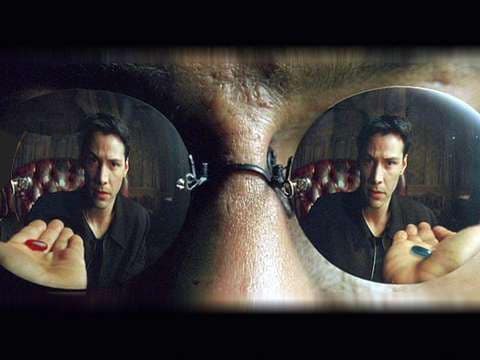
So if dreams are so realistic how can we really know if we are not dreaming now? Or even better how can we know that we are not living in a simulated reality, like the matrix or even a video game? As stupid as it sounds, these theories are gaining some momentum in the world of philosophy and science these days. And when you really think about it, there seem to be no simple arguments against these theories. After all, illusions can seem as realistic as reality is. So let's look a little closer at the idea of a simulated reality.
As we've seen in the last article, the idea that reality might be an illusion was popularized by the famous work of Rene Descartes called Meditations on First Philosophy. The modern version of a similar argument that reality is just a computer simulation was proposed by Swedish philosopher Nick Bostrom in 2003. The simple version of Bostrom's argument goes as follows:
i) It is possible that an advanced civilization could create a computer simulation which contains individuals with artificial intelligence.
ii) Such a civilization would likely run many, billions for example, of these simulations (just for fun, for research and other similar reasons).
iii) A simulated individual inside the simulation wouldn’t necessarily know that it is inside a simulation.
Then the ultimate question is — if one accepts that the above premises are at least possible — which of the following is more likely?
a. We are the one civilization which develops AI simulations and happens not to be in one itself?
b. We are one of the many (billions) of simulations that has run?
In greater detail, his argument attempts to prove the trichotomy, either that:
i) Intelligent races will never reach a level of technology where they can run simulations of reality so detailed they can be mistaken for reality (assuming that this is possible in principle);
ii) Races who do reach such a sophisticated level do not tend to run such simulations;
iii) We are almost certainly living in such a simulation.
This argument goes beyond scepticism, (i.e. we cannot be sure if reality is not an illusion) and claims that the odds are that we are actually living in a virtual reality. What's even more interesting that some philosophers believe that eventually beings in a such a simulation would become so advanced that they would create their own simulations, so we could be living somewhere in this web of simulations. But let's forget these crazy ideas for a while and let's imagine that we are indeed living in an advance computer simulation created by some advanced alien race or humans of the future. Would it be possible to somehow detect that our reality is just a simulation?
If you had a choice to find out whether our reality is real, would you choose to know?
Perhaps science hides the answer to this question. Physicist Richard Feynman once said that physics is like sitting in a corner of a huge chess board. Once in a while you see some chess figures moving in a specific way, but you can't see the whole board. So you observe the movement of the figures until you understand how every figure moves. So maybe we are like these lone observers on a huge chess board, which we call the universe. By studying the laws of the universe we are moving closer to understanding the real meaning of it. That's exactly why some scientists believe that if we had the so called theory of everything, which would describe all the laws of the universe in one equation, we could find the meaning of the universe and possibly understand its purpose and we might even find some clues about the architects of the virtual reality that we call our universe.
Another clue about the non-reality of our world would be the so called bugs or system errors of the simulation. These bugs would probably appear as physical anomalies, which we couldn't explain, and would probably occur very rarely. On the other hand, one might argue that a sufficiently powerful simulation would monitor the thoughts of the inhabitants of the virtual reality and delete their memories after the discovery of a bug. Another possibility is that these bugs are a part of our reality, for example some physical anomalies or even some events in our everyday life were never supposed to happen, but they were left in the simulation as deleting them would cause suspicion
Another possibility is that there might be so called Easter eggs (secret messages left by the designers). For example there are many enthusiastic mathematicians who are looking for clues and hidden messages in the numbers of natural constants like pi. The problem with this idea is that it depends on an assumption that the creators want us to find out about the fact that we are living in a simulated reality. Nevertheless, the idea of Easter eggs sounds amazing. It would be a great scenario for a sci-fi movie.
Nick Bostrom about his ideas:
There are many ideas regarding the processing power of the computers that supposedly simulated our reality. Assuming they don't have infinite processing power, we can conclude that there could be a limit to the processing power, which would materialize similarly to pixels in video games that we create. Old video games made for low processing power computers look grainy as you can see every pixel. Whereas modern computers with high processing power make it hard to distinguish between thousands of pixels. Similarly, we could find similar phenomena in the microscopic world. There are scientists who actually think that Heisenberg uncertainty principle is evidence for the limit of processing power of the computers, which simulate our reality.
These are all very interesting ideas, but is it, at least in theory, possible to check them? It seems that the only chance we have is to observe the laws of physics and look for some clues, which would indicate that our universe is just a simulation. Of course one might say that the designers could create our reality in such a way that it wouldn't be possible to detect that it's a simulation from the inside. Still there are actually scientists, who believe that there are some similarities between the laws of the universe and the computer software codes. But, whether it's just another crazy idea or it's actually just crazy enough to be true, nobody knows. Well, only time will tell.
In the late 1500's, everyone knew that heavy objects fall faster than lighter ones. After all, one of the greatest ancient Greek philosophers Aristotle said so. Yet, Galileo, who at the time held a chair in mathematics in the University of Pisa, decided to do an experiment to test out Aristotle’s claims.
Galileo's experiment recreated:
So as the story goes (which is probably not true, but hey, it’s still a great experiment), Galileo threw two objects, one heavy and one light, from the leaning tower of Pisa. As we all know from high school, Galileo proved that lighter objects fall at the same rate as the more massive objects.
Galileo is often regarded as the father of experimental physics, as he was one of the first scientists, who started experimenting to test out theories of the time. The described experiment showed that scientific investigation is by far more important than personal authority of famous scientists and philosophers.
Physics relies not only on inventive theories, which have formed our understanding of the universe, but also on important experiments, which test our theoretical predictions. So let’s look back to the history of science at the most famous and influential experiments of all time. This is a list of 10 greatest physics experiments in no particular order.
10. Galileo's experiments with rolling balls down inclined planes
This simple experiment contains a board 12 cubits long and half a cubit wide (about 20 feet by 10 inches) and a cut out groove, as straight and smooth as possible, down the center. The experiment procedure is also very simple – a ball is released from the inclined plane, timing the time with a water clock — a large vessel that emptied through a thin tube into a glass. After each run the measurement of time would be compared with the distance travelled.
More about Galileo's Experiments:
Now you might thing that such a childish experiment, wouldn’t give you much insight on the dynamics of moving bodies, but, actually, Galileo Galilei used this experiment to test his understanding of moving bodies. His observations later gave inspiration to the other great science figure – Isaac Newton and his 3 famous laws.
Here we have another amazing video from Horizon series. It's a full interview with the famous Nobel laureate Richard Feynman. Feynman talks about his youth, inspiration and how he really sees the world around us. Furthermore, it contains some amazing facts from his life. Enjoy!
Thanks once again to SevenSevenSevenka for uploading the full video.
Thanks for reading and watching. If you like my stuff please subscribe, comment and follow. Cheers
When it comes to modern cosmology not many physicists are more unique and popular than Stephen Hawking. Besides being a great scientists, Hawking has also become a world wide celebrity - he's often featured in science documentaries, radio shows and even science fiction. But what made Hawking so popular?
Perhaps Stephen Hawking became so popular due to his most controversial discovery of the so called black hole information paradox. Long story short, Hawking discovered that black possibly destroy the information of what fell into them. This great Horizon documentary tells the story of this great discovery. In addition it has some interesting biographical facts about Stephen Hawking plus all the cool stuff that usual comes with Horizon documentaries like cool visuals and great narration.
What is really great about this documentary is that it also features the famous theoretical physicist from Stanford - Leonard Susskind. Susskind, as many of the physicists of the time, did not believe that black holes might swallow the information, so he, for many years, tried to created a theory, which would resolve the information paradox. This gave rise to a very interesting professional competition between these two great scientists.
Thanks for checking this out. If you like my stuff, please comment and follow. Cheers.
When it comes to physics, the first person that comes to our heads is Albert Einstein. The famous picture of this colossal figure of science taken in 1951 shows the charismatic and humorous side of the genius. In a sense, this picture captures the whole essence of Einstein as a scientists - a brave risk taker and a rebel among the genii of physics.
Everybody these days knows about the successful theories of Einstein. However, not many people know about the most important and definitely the hardest theory that Einstein never finished - the theory of everything. This grand theory would be the greatest achievement of theoretical physics, as it would combine all the known laws of physics, explain all the forces and behaviour of particles and large objects such as planets, galaxies and the universe itself.
So let's check out this great documentary, that tells a story of Einstein's unfinished theory of everything. It contains great actors as well as interesting biographical facts. Enjoy.
Thanks forQuantumLeep365for uploading the full documentary
Thanks for watching. If you like my stuff feel free to subscribe and comment. Cheers!
Everyone, who came across complex numbers in mathematics knows how strange they are. But do these numbers really exist? Are they important?
First let's look at what complex numbers are. More than 2 thousand years ago, ancient Greeks believed that every number can be expressed as a fraction, for example 1/2, 2/5 and so on. However, they were shocked, when they realised that a hypotenuse of a right triangle with sides of length 1 cannot be expressed using natural numbers or fractions. As we all know, the length of the hypotenuse of such a triangle is a square root of 2 (which is 1.414...). This showed ancient Greeks that there is more than a single number system, in this case it's the real number system (which includes counting numbers as 1, 2...., negative numbers, fractions, square roots and so on).
Until complex numbers were found and were used in mathematics, it was thought that all the number systems were already found. So what is a complex number? It's easy. It's a number that is a square root of a negative number.
But do such numbers have any physical meaning? After all, even when calculating simple quadratic equations, younger students are told to ignore negative answers, as negative areas do not exist. Surely such negative areas might not exist, but complex numbers constantly show up in various applications, which shows that even though we can't visualise a square root of -1, it still exists in mysterious ways.
The strange thing about complex numbers in fact is that they almost seem to be existing and not existing at the same time. For example, when solving differential equations, in electrical engineering (also in many other fields), the behaviour of electrical circuits depends on whether the solutions are real or complex numbers.
Another example is quantum mechanics. The wave function, that describes behaviour of microscopic particles is found using complex numbers. That is something real and physical is described by laws which use complex numbers.
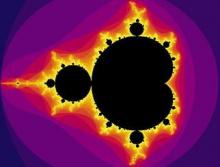
The so called Mandelbrot Set shows a set of complex numbers generated by a simple equation:
Some physics theories even use complex number plane to represent time, whereas real numbers represent spatial dimensions.
But the real question is whether complex numbers represent something physical. When it comes to square roots of positive numbers, we can clearly visualise what they mean. For example, if we know an area of a rectangle is 16 meters, we can take the square root of this number and find out that the side of the rectangle is 4 meters. But when it comes to complex numbers, a similar situation cannot be found.
So as you might have already noticed I'm a fan of the Through the Wormhole with Morgan Freeman series. It's a really great TV show that focuses on various intriguing problems. But what if you like this show but don't have a TV or you can't watch Discovery or Science channels?
Well luckily these days almost every great show can be watched online. So I dug up some places where you can watch this great show online for free. Plus I added a preview of the first episode, which can be found on Youtube.
The links are bellow, but be sure to support the developers of the show and buy the DVD if you really enjoy the show ;]
Isaac Newton, inspired by the falling apple in his yard during the Great Plague, created his greatest work – the law of gravity. This wonderful and simple law predicted the movements of planets, stars and even galaxies. Even though, Newton’s calculations could precisely predict movement of any stellar object, the great genius had no idea how gravity actually worked.
More than 3 centuries later perhaps the greatest physicists ever, Albert Einstein, created his famous special and general theories of relativity. Even though Newton's law of gravity was very precise, there were some cases when movement of the planets and galaxies could bot be explained by this simple law. However, Einstein's general relativity combined with Newton's laws could explained almost all the movements of the planets, stars and galaxies. The great thing about these theories is that they can be used to find out more about the universe. For example by observing the rotation of the outer stars in the galaxy, scientists could calculate the total mass of the galaxy. This is where the whole strangeness started. When calculating, the mass of various galaxies scientists realised that those galaxies move in such a way as if there was more mass in them than we can observe. This meant that either there was something wrong with current theories and calculations or there was some invisible matter, which interacted only gravitationally. And since Einstein's theories have been tested and proved dozens of times, scientists came to the conclusion that there is some kind of strange invisible matter called dark matter. This is our strange fact of today.
Even more shocking is that there is almost 6 times more dark matter than ordinary matter in our universe. This means, that even now, there's invisible dark matter in your room, which cannot be seen or detected in any way, except gravitationally.
We already discussed time travel, which is a huge topic, so let's relax for a while and look at some random strange facts.
Everything is Moving
More than 2000 years ago ancient Greek philosophers used to argue, whether anything ever changes. Some thinkers were convinced that everything is constantly moving and changing, whereas other wise men believed that nothing moves. Now you might think that believing that nothing ever moves is strange, as you can clearly move as well as many other things around you. But a guy named Zeno actually had some interesting arguments to back up his beliefs. The so called Zeno paradoxes supposedly show that movement is only an illusion. The simplest form of Zeno's paradox goes as follows: suppose you have to walk from point A to point B. In order to do that you firstly have to walk half of the distance, however to do that you should firstly travel one forth of the distance and so on. Since there is infinity of such parts of the distance, you can never even start moving.
Today we know that Zeno's conclusions were wrong, as simple maths can help solving the paradox. By adding an infinite number of fractions you can get a finite answer.
So is everything moving then? The answer is probably yes. Even though many objects around us appear to be stationery, in reality, everything is constantly moving. If you had a powerful microscope, you could actually see that molecules of every object are constantly moving due to temperature (temperature is in fact kinetic energy of molecules) and since temperature cannot reach absolute 0 Kelvins, molecules always move. Furthermore, as you are sitting comfortably in your chair, Earth is flying in outer space at thousands of miles per hour. But that's not all, as even space itself is expanding every moment.
Sugar Cubes and Humans
I bet you already knew that atoms are basically 99.9999..% empty space. But here's another amazing fact - if you would take all the matter that makes up all humans on Earth, remove the empty space from atoms and squeeze the matter, you could compress it to a size of a sugar cube.
Another fun fact is from special relativity. As an object moves in high speeds it becomes more massive. Hey but don't worry all of you who are trying to lose weight, as long as you're not moving at almost the speed of light, you will be OK.
Earth and the Moon
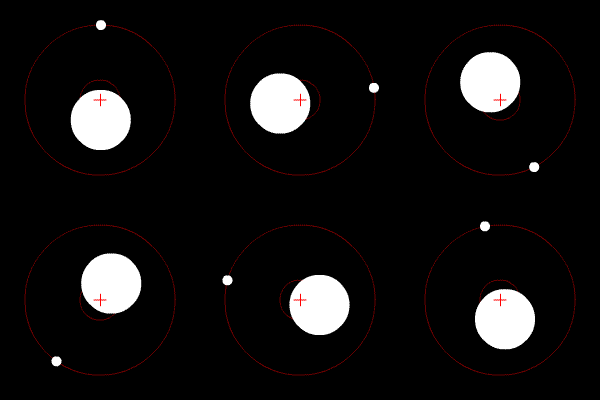
Everybody knows that the Moon orbits Earth, but did you know that the opposite is also true? In fact, both Earth and the Moon orbit their common centre of mass, which happens to be inside of Earth (as our planet is far more massive than its satellite).
When I was a child and was only starting to learn physics, one thing for me was stranger than anything else. You might guess it was the strangeness of quantum mechanic. But actually (even though quantum mechanics is very very strange and fascinating) the thing that really caught my attention was time travel.
Time travel is one of the most popular subjects of science fiction. Starting with Star Trek ending with newer shows like Lost most of the sci-fi shows have a fare share of time travel. But have you ever wondered if time travel is possible? Well the answer is yes! And that is our strange fact of today.
First let's look at time travel to the future. Even though Einstein's special theory of relativity is a part of high school course, not many people know that time travel to the future is actually a scientifically proven fact. It's not only proven, it's a big part of communication technology, as even GPS services wouldn't work without the precise calculations from the special and general theories of relativity. But what does this have to do with time travel?
Einstein back in 1905, when his special theory of relativity was created, showed, that time runs slower for fast moving bodies. To get a grasp of how this works, let's check out this mechanism called photon clock. It consists of two mirrors with a photon (particle of light) trapped between them. Every time the photon hits the mirror a unit of time passes.
When the clock is not moving, the photon just bounces up and down vertically. However, if the clock is moving, as you can see in the image, the photon needs to go diagonally from the upper mirror to the lower one and vice versa. It's clear that when the clock is moving, the photon has to travel a greater distance from one mirror to another. In other words, time passes slower for a moving photon clock. But the interesting thing is that this is true not only from photon clocks, but for any moving objects, as Einstein showed in his theories. Even the photons in the atoms of our bodies must travel a longer distance between the nuclei and electrons when our bodies are moving.
This simply means that the faster some object moves, the slower time runs for it. This gives rise to the famous twin paradox. It goes like this. Let's say there are two twins. One of them decides that life on Earth is boring, so he jumps on a fast rocket and flies away for let us say 50 years at a speed of 75% of light speed. Then after 50 years, he get's back to Earth, and is amazed, as his twin brother appears to be 25 years older than him.What happened was that time ran slower for the brother, who was in the rocket, which basically made him travel to the future, as time on Earth was running faster.
A video about Twin Paradox:
You might be wondering does this have any proof? The answer is yes. Two super precise atomic clocks measured time, while one of them was in a plane flying around the world, whereas the other clock was stationary on the ground. The difference in the clocks, when the plane completed its journey, was a very very small (nanoseconds), but it agreed with Einstein's theories.
So time travel to the future is really possible, though our current technology is not advanced enough to make use of it. Rockets, travelling at almost the speed of light would be required to travel to actually travel to the future. Also going back from the fancy future would be much more difficult (some believe even impossible), but more about that next time.
Thanks for reading! For more physics articles, lectures and videos, please follow and subscribe.


 1:14 PM
 silentbob14