
Showing posts with label quantum mechanics. Show all posts

Wednesday, January 4, 2012

About the Meaning of Quantum Mechanics


Everyone who knows at least the basics of quantum mechanics knows how tricky and counter intuitive this highly successful theory is. Even one of the greatest minds among the developers of quantum mechanics, Richard Feynman, once said  that "if you understand quantum mechanics, you don't understand quantum mechanics."

One of the few similarities between classical mechanics and quantum mechanics is that there is a main equation which can be manipulated mathematically to derive the equations which describe how a physical system behaves.  For example Newton's  law's (+ the law of gravity) can be used to derive almost all the equations needed to describe classical physical systems (pendulums, rolling balls, sliding blocks and all such stuff).Similarly Schroedinger's equation can be manipulated to derive the wave function and the probability distribution, which tells us, for example, where it is most likely to find a particle. So why is it that quantum mechanics has the reputation of one of the most counter intuitive theories of physics?

It's mostly because of many paradoxes, which seem illogical and too strange to be real sometimes. For instance, it's all perfectly normal in terms of the laws ruling the quantum world, for a particle to be in two places at once. Also, a elementary particles and other objects have properties of both waves and particles. And I don't even wanna start talking about strangeness of quantum entanglement and the double slit experiment.

So what all do these paradoxes  tell us about reality? After all, it's hard for most of the people to believe that particles in reality can indeed be in two places at once and so on. This is where the opinion of scientists splits - some say there is no objective reality, some say there is some kind of objective reality but it can't be detected (due to the Heisenberg principle) and others believe that quantum mechanics is an unfinished theory. These opinions are reflected in a variety of different interpretations of quantum mechanics.

Actually, I've just found a great article, which talks about various interpretations of quantum mechanics and what they tell us about reality. You can find the link bellow. Also be sure to check out the website it is on. Nova has a bunch of great physics videos as well as amazing library of articles and other useful stuff.

Debating the Meaning of Quantum Mechanics

NOVA


Don't forget to subscribe, follow and comment. Cheers


Monday, July 25, 2011

So Can Electrons be at Two Places at Once?


One of the strangest things that you can hear about quantum mechanics is that microscopic particles in some instances can be in more than one place at a time. But how can this be true?

To understand this let's look at the most important experiment in quantum mechanics - the double slit experiment.  The idea of this experiment is simple. You send particles and waves through a double-slit device and observe the results on the screen. Naturally waves and particles, which are not microscopic behave differently. However, if you send a bunch of microscopic particles, like electrons through the double-slit device you get a very surprising result - electrons behave like waves. Even if you send them one at a time, they still create an interference pattern, which is typical for waves, which,of course, pass both slits at a time.

The result of the double-slit experiment using simple particles:


Source

One of the explanations for this is that electrons somehow exist in two places at a time, that is the same electron passes both slits at the same time. Of course there are scientists who don't believe in this idea. But guess what, you can't check which slit the electron passes, as if you  try to detect it, the interference pattern on the screen disappears, that is the electron then simply passes through one of this slits.

The result of the double-slit experiment using microscopic particles:

Source

In quantum mechanics, the electron is said to be in a superposition, that is it is at many places at the same time and until you observe the electron, you can't tell where it is exactly. However, this is just the mathematical way of explaining what we can observe experimentally. Nobody really knows in the electron actually is at more than one place at the same time.

Naturally scientists are wondering if it is possible to put a non-microscopic object in a superposition. One of the most ambitions experiments by scientists at the Max Planck institute in Germany, will try to put a glass sphere, which is 40 nanometres in diameter, into a superposition. By using a sensitive laser to "bounce" photons of the sphere, they will try to put it in a quantum superposition, that is it will be in more than place at once. If the experiment is successful it will be the most sensitive test of quantum theory yet.

Thanks for checking this out. Feel free to subscribe and comment. Cheers.

You might be interested in:


Sunday, July 24, 2011

So What is This Quantum Entanglement ?


These days we can constantly hear term "quantum entanglement". But what really is quantum entanglement? 

Stanford Encyclopaedia of Philosophy gives the following definition: "Quantum entanglement is a physical resource, like energy, associated with the peculiar nonclassical correlations that are possible between separated quantum systems. Entanglement can be measured, transformed, and purified."

In human language quantum entanglement means an inescapable relationship between quantum systems, such that if one part of the system is measured for some quantity (for example spin or polarization), other part instantaneously changes to give the same result.  
Another example of QE:


Perhaps the best example of quantum entanglement would be the original mind experiment by Albert Einstein, which introduced quantum entanglement. Let's imagine two photons were entangled and then shot off in different directions, each traveling at the speed of light, and you were to observe and measure the spin of one of the photons. Would the other photon “know” instantaneously and change its spin accordingly? Einstein argued that it wouldn't happen, as it would violate special theory of relativity, as it would be a form of faster-than-light communication.

Back in the early 1980s science became advanced enough to test the famous Einstein's thought experiment. French physicist Alain Aspect conducted a series of experiments which tested the nature of entangled photon pairs and how they might share information. What he found was amazing! In fact, the measurement of one photon did affect the state of its entangled partner, instantaneously!  

Today scientists keep on experimenting with quantum entanglement. In May of 2010, Chinese scientists successfully achieved quantum teleportation of information over a distance of 10 miles. In January of 2011, physicists S. Jay Olson and Timothy Ralph of Australia’s University of Queensland produced the mathematics to support the quantum teleportation of information through time, from the past to the future.
You might be interested in:


Tuesday, July 19, 2011

Free Quantum Mechanics Lectures from Yale University


Quantum mechanics is one of those tricky subjects, which are hard to learn from books alone. It's one of those branches of physics that are best understood when explained by an experienced lecturer. That's why I present you this mini series of lectures by professor Ramamurti Shankar from Yale university.

There 7 lectures in total, which cover most of the main topics of QM starting with double slit experiment and De Broglie wavelength and ending with various postulates of QM.

The lecturer is really good, as he explains all the concepts in an easy to understand way and always keep asking students if they're following. In addition, he always tries to give practical examples of physics concepts, which is great.

Here's the first lecture. The link to other lectures is below the video.


Links to other lectures: Link 1
                                  Link 2

You might be interested in:

Monday, July 4, 2011

Quantum Mechanics by Some Strange Guy


So what we have here is a video from a "Stand-Up Physicist" series where this strange guys tells you all about quantum mechanics. I don't know what I like more - the fact that this video is really informative, or the fact that this guy does some weird stuff.

Anyway, if you like a quick "For Dummies" course be sure to check this out. Oh and by the way, for those who would like to know who this strange guy is, his name is Doug Sweetser.


Thursday, June 2, 2011

Free Will?


So lately I've been reading this book called Asymmetries in Time by Paul Horwich. It's a book on philosophy of science, mostly grappling the problems regarding the nature of time. I don't really like philosophy of science books, because i find it strange when philosophers grapple such problems as the nature of time by only playing with words and concepts. I truly believe that such a problem as a nature of time can only be solved by scientists.

But anyway, back to my point, I stumbled upon a chapter about a philosophical theory called fatalism. From what I understand this theory states this: since every event that will happen in the future depends on the past events (a chain of past events, which cause the future events) and we cannot change the past, the future is fixed. In other words, everything in our universe is already predetermined. 

But aren't we making random and free decisions everyday? Well it's a hard question. But if you think about it for a while, you can come to conclusion that every event has a cause. That is, every action and even every thought has a cause and is predetermined by the past thoughts and actions. Actually, if a supercomputer of an amazing power would exist, we could calculate and predict our future thoughts and actions, that is, our future seems to be already predetermined.

So the big question is: are we really just simple puppet dolls, which have no free will, as our futures are fixed. Well if it is the case, then it seems scary and unpleasant - after all, everyone wants to rule his life.

The interesting thing is that we can't really determine everything with a perfect precision. That is, due to Heisenberg's uncertainty principle, the microscopic world of smallest particles is ruled only by probabilities. This opens some space for randomness in our universe. Actually some scientists even believe that a random quantum fluctuation could have caused the big bang.

So the important question is as follows: is our universe deterministic or is it random. In either way, it leaves little space to free will, as even if the world is random, we can't control this randomness.

So are we just simple puppet dolls, who have a predetermined destiny, or are we lost in an ocean of randomness? Or maybe all of this is wrong, and there is still place for our free choices in our universe. Nobody knows... And after all, would it be interesting if we knew?

Sunday, April 3, 2011

Basics of Quantum Mechanics Lesson 4


So last time we calculated the wave function of a free moving particle and got the following answer:

SE for a free moving particle:
Solution for this equation:  

So what do these equations tell us about the free moving particle? To find the answer to this question we need to find the probability density function. If you recall, the probability density function is basically just the square of an absolute value of the wave function. So by calculating the probability density function we would get:


|Psi |^2 = Psi x complex conjugate of Psi =
= A(cos(kx − wt) + i sin(kx − wt))A(cos(kx − wt) − i sin(kx − wt))
= A^2(cos2(kx − wt) + sin2(kx − wt))
= A^2


Now if you look at the result more carefully, you should realise that there's some strange stuff going on. The probability density function is constant, that means that the probability of finding a the particle in any point of space is equal. In more simple words, you have the same probability of finding the free moving particle in your room and somewhere in the other side of the universe. This is due to the fact that we have not taken into account the uncertainty of the momentum of a particle.


So you might be asking  - why are we studying free moving particles, while in reality most of the matter is situated in confined atoms and molecules. And you're definitely right, so let's look at another system, which might help us understand the behaviour of electrons, which are "trapped" in an orbit of an atom.


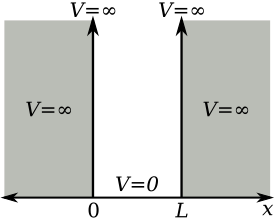
The easiest way of understanding simple atoms or similar systems is using a thing called infinite potential well. That is a system in which a particle is trapped between infinite potential "walls", which can be for instance be various electric of magnetic fields or anything similar, which confines the particle in a given space. After all, in a sense electrons orbiting a nucleus are also in a similar potential well - if they get too close to the nucleus, they are pushed back, if the get too far they are attracted back. 


Infinite potential well:


So how does particle behave in such a well? Well let's firstly imagine what would happen in a classical situation, let's say for a tennis ball trapped between two walls. It's clear that (neglecting gravity, which would eventually bring the ball down) any position between the walls has the same probability of finding the ball there.

However, in quantum mechanics, things are different. We already know that particles tend to behave as probability waves, so it's clear that the probability of finding the particle in any point of space will not be equal( a good analogy of a wave in a sort of potential well is a rope fixed at two places and oscillating).


So how can we find out at which points of space we are most likely to find the particle? By solving the Schrodinger equation of course.

And since this is a basic course we're not gonna bother ourselves with the process of solving the SE. We're just gonna skip right to the solution which is:

Wave function for a particle confined in a infinite potential well: Psi(x) = Asin kx

Now to calculate the probability density function, we need to apply the initial conditions of the system - as we know the particle can't be in points of space, which are beyond the boundaries.

In an infinite potential well the boundary conditions imply:
 Psi (0) = Psi  (L) = 0.
Resulting in the limitation that k must have one of the discrete set of values
kn = (pi . n)/L , where
n = 1, 2, 3 . . .


Now when we know k, we can find allowed energies.
Using  E= (p^2)/m and De Broglies wavelength p= h/ lambda = hk/ 2pi gives the following:

En = (h^2 . n^2)/(8mL^2)
 n = 1, 2, 3 . . .


The allowed energies for the trapped particle are quantised according to the value of
n which is known as a quantum number.


Note that we can calculate the quantum number using simple calculations, which we'll look at later. It's important to notice that for macroscopic objects n is very larger, which gives rise to the so called correspondence principle - the idea that if n is very large (which is definately the case for macroscopic objects), quantum mechanics prediction become similar to classical physics prediction.

And we can see this by finding the probability function of the infinite potential well, and graphing it with different values of n:


As we can see as n grows, the wavelenght of the wave in the graph becomes shorter. In n was very very big, it would look as every point in the confined space has the same probability (like in the classical physics case).


So that's all for now, thanks for reading!


LINK to lesson 3
LINK to lesson 2
LINK to lesson 1

Sunday, February 20, 2011

Basics of Quantum Mechanics Lesson 1


So I've been learning quantum mechanics for some time now and I can say that it's a charming subject. It's hard to find another part of physics which makes you panic and adore it at the same time. So that's why I decided to create these simple lessons of the basics of quantum mechanics.

I tried to study quantum mechanics by myself a couple of times in the past and what I found out was that it is really hard to find good lessons, lectures or books about the basics online. I mean you can easily find good e-books about the whole philosophical part of quantum mechanics, which explain the basic principles, but hardly give you the real taste of the subject with whole the maths part of it. On the other hand, you can find a lot of hardcore stuff, like lectures and videos which require you to know the subject at a very high level. So as you can see it's really hard to come up with some real basic quantum mechanics with all the appropriate maths for a beginner. So I decided to make these basic lessons that give you all the basic stuff you need.

So firstly let's look at some basic information about quantum mechanics: Quantum mechanics, also known as quantum physics or quantum theory, is a branch of physics providing a mathematical description of much of the dual particle-like and wave-like behavior and interactions of energy and matter. It departs from classical mechanics primarily at the atomic and subatomic scales, the so-called quantum realm. In advanced topics of quantum mechanics, some of these behaviors are macroscopic and only emerge at very low or very high energies or temperatures. The name, coined by Max Planck, derives from the observation that some physical quantities can be changed only by discrete amounts, or quanta, as multiples of the Planck constant, rather than being capable of varying continuously or by any arbitrary amount. For example, the angular momentum, or more generally the action, of an electron bound into an atom or molecule is quantized. While an unbound electron does not exhibit quantized energy levels, an electron bound in an atomic orbital has quantized values of angular momentum. In the context of quantum mechanics, the wave–particle duality of energy and matter and the uncertainty principle provide a unified view of the behavior of photons, electrons and other atomic-scale objects.


So let's start easily. At the heart of quantum mechanics there is the famous Heisenberg uncertainty principle. This principle appears in all parts of quantum mechanics so it's important to know it by heart and get it out of the way early.

Heisenberg uncertainty principle:      


 So what does this mean? It means that the product of the uncertainty in position of a particle and momentum must always be higher than some constant quantity, which is h bar/2, where h bar= h/2pi (Planck constant). This means, that if you try to detect a particle you can only do it with a certain precision. For instance, if you detect it's position with a very small uncertainty then you will have a very big uncertainty in momentum of the particle. 

Now this is very strange, because we are so used to the "fact" that we know the position of anything very accurately. And now suddenly we realise that when it comes to microscopic world, we can't even find the exact position of the particle. But this is just the beginning of the whole strangeness of the quantum world.

But why can't we detect particles position or moment with a big precision? Well it's mostly because of the way we detect particles. Long story short, we detect a particle by shooting a photon at it (a particle of light). However, a photon also has some momentum and as strange as it sounds you can simply "knock" a particle away with a photon. Also, if you want to find out the position of a particle with a high precision, you must use a high frequency light wave (a high energy photon, where the energy of a photon E is given by E=hf, where h- Planck constant and f- frequency) which naturally has a bigger momentum, which causes a particle to be knocked away at a high velocity. This is exactly what causes the uncertainty in the momentum.


Now if this looks strange to you then don't worry. I mean the whole world was in shock when quantum mechanics was established. One of the most shocking things was the collapse of the Newtonian determinism. This is an idea that if you know enough information about a particle, you can calculate it's position and velocity in the future, that is if you have enough information you can tell the future. You can imagine how shocked the world of science was when after a couple of hundread years suddenly they realised that you can't actually tell the particle's position and momentum with an exact precision (thus you can't tell the future of a particle with an exact precision). Long story short, the world went upside down in the beginning of the XX century - particles became wave - particle probability waves, nothing was certain anymore, electrons decided to show up at two different places at one time, other particles started to travel back in time and so on. Whole hell broke through in the world of science back in those days.  All of these crazy things brought to the world of science by the quantum mechanics can really cause headaches, but hey don't worry, it can be explained in a very elegant way. But we'll look at it next time.Thanks for reading!

PS. I'm not an expert of quantum mechanics, so if you notice any mistakes feel free to tell me. Thanks!


Design by Free WordPress Themes | Bloggerized by Lasantha - Premium Blogger Themes | Lady Gaga, Salman Khan