Showing posts with label mathematics. Show all posts

Friday, July 15, 2011

Wonders of Mathematics: Complex Numbers


Everyone, who came across complex numbers in mathematics knows how strange they are. But do these numbers really exist? Are they important?

First let's look at what complex numbers are. More than 2 thousand years ago, ancient Greeks believed that every number can be expressed as a fraction, for example 1/2, 2/5 and so on. However, they were shocked, when they realised that a hypotenuse of a right triangle with sides of length 1 cannot be expressed using natural numbers or fractions. As we all know, the length of the hypotenuse of such a triangle is a square root of 2 (which is 1.414...). This showed ancient Greeks that there is more than a single number system, in this case it's the real number system (which includes counting numbers as 1, 2...., negative numbers, fractions, square roots and so on).

Source

Until complex numbers were found and were used in mathematics, it was thought that all the number systems were already found. So what is a complex number? It's easy. It's a number that is a square root of a negative number.

But do such numbers have any physical meaning? After all, even when calculating simple quadratic equations, younger students are told to ignore negative answers, as negative areas do not exist. Surely such negative areas might not exist, but complex numbers constantly show up in various applications, which shows that even though we can't visualise a square root of -1, it still exists in mysterious ways.

The strange thing about complex numbers in fact is that they almost seem to be existing and not existing at the same time. For example, when solving differential equations, in electrical engineering (also in many other fields), the behaviour of electrical circuits depends on whether the solutions are real or complex numbers.

Another example is quantum mechanics. The wave function, that describes behaviour of microscopic particles is found using complex numbers. That is something real and physical is described by laws which use complex numbers.

The so called Mandelbrot Set shows a set of complex numbers generated by a simple equation:
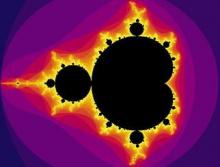
Source

Some physics theories even use complex number plane to represent time, whereas real numbers represent spatial dimensions.

But the real question is whether complex numbers represent something physical. When it comes to square roots of positive numbers, we can clearly visualise what they mean. For example, if we know an area of a rectangle is 16 meters, we can take the square root of this number and find out that the side of the rectangle is 4 meters. But when it comes to complex numbers, a similar situation cannot be found.

Sunday, June 12, 2011

How to Learn Calculus The Simple Way


So I guess it's safe to say that calculus is one of those topics, which are for some reason really hard to grasp for most of the students in high school and later in college. Maybe, it's because calculus is really a unique branch of mathematics, that is, it's different from most of the mathematics that we are taught in high school (most of which was developed by ancient Greeks, of course with some slight improvements by later mathematicians). After all, it was developed by greatly gifted mathematician and scientist Isaac Newton (and Leibniz too).

I myself remember having some problems with calculus. It's not that I didn't grasp the mathematics, it was just most of the time I didn't have the feeling what I was calculating, or what's the sense of derivatives, integrals and so on. And what really helped me, when I was revising before going to college, was some great books and video lectures.

Firstly, I really enjoyed these simple YouTube lectures by Prof. R.Delaware. I like this guy because he really doesn't presuppose that you have some past knowledge about calculus (except of course some basic mathematics from high school), he simply explains everything as it was being explained for the first time.

These lectures cover all the basic high school calculus and some of the basic college calculus. Basically the two main parts are differentiation and integration.

So here's the first lecture:
And you can find all the other lectures on calculus and other topics HERE.

If you're looking for a book specifically that would help you with calculus I highly recommend Calculus for Dummies. It's a very basic and fun to read book, which will give you all the required knowledge of high school and some college calculus. Also it contains very nice diagrams, which give you a great visualisation of calculus concepts. Also it contains some neat tricks how to do calculus problems.


Thanks for reading! If you enjoy my blog feel free to subscribe and comment. Cheers!


Monday, May 2, 2011

3x3 Magic Square


Last time we looked at magic squares in general and found out that the most simple magic square is of order 3x3.

There is beautiful legend about the discovery of this popular magic square.

As the story goes, in ancient China there was a huge deluge: the people offered sacrifices to the god of one of the flooding rivers, the Lo river (洛水), to try to calm his anger. A magical turtle emerged from the water with the curious and decidedly unnatural (for a turtle shell) Lo Shu pattern on its shell, which contained the numbers in an aray of a magic square. As the legend says, these numbers showed the people how often and how many sacrificies should be given to calm the Lo river.

The Lo Shu square containing the numbers on the turtle's back:


So what are these magic numbers?

It appears that all magic squares obey some rules. For instance all normal magic squares of un-even order (of  n x n order, where n = 3,5,7...) have a special number at the centre called the magic constant.

So for a 3x3 magic square you have 1+2+3+4+5+6+7+8+9=45. In a magic square you have to add 3 numbers again and again. Therefore the average sum of three numbers is 45:3=15. The number 15 is called the magic number of the 3x3 square.
You can also achieve 15, if you add the middle number 5 three times.  You can reduce 15 in a sum of three sums eight times: 15= 1+5+9;  15= 2+4+9;  15= 2+6+7;  15= 3+5+7


15=1+6+8;  15=2+5+8;  15=3+4+8 ; 15=4+5+6

The odd numbers 1,3,7, and 9 occur twice in the reductions, the even numbers 2,4,6,8 three times and the number 5 four times. Therefore you have to place number 5 in the middle of the magic 3x3 square.

The remaining odd numbers have to be in the middles of a side and the even numbers at the corners. 

*The formula to find other magic constants is:

M= [n(n^2 +1)]/2

So by using the information above we can see that there exists only 1 magic 3x3 square (of numbers 1-9). Of course you can rotate the magic square in total of 8 ways, which gives all the possible distributions of the numbers in a 3x3 magic square.

Thanks for reading!

Friday, April 29, 2011

Wonders Of Mathematics - Magic Squares


So one of the books that I really enjoyed recently is the famous Dan Brown's "The Lost Symbol". If you read the book (and you should) you might have noticed that it has many interesting maths references. One of which is hidden in the famous Albrecht Dürer's 1514 engraving Melencolia. It's a very special magic square.

But what are these magic squares? Magic squares are very interesting square arrangements of numbers. The numbers are arranged in such a way, that the sum of all columns, rows and diagonals is equal to the same number.

Magic squares come in different sizes that are called orders, for instance 3x3, 4x4 and so on (it's just a number of rows and columns). As for the sum that is constant for columns, rows and diagonals it's called the magic constant.

 
Image Source

The most simple magic square is of order 3x3 (it's easy to see that 2x2 squares are not possible). But how do you construct such a magic square, without relying to guess work? There are various rules, which can help you construct the square faster, however some guess work is still essential.

So when stumbled across these magic squares, I decide it would be fun to found a 3x3 magic square without any help. It's quite fun, well at least much more fun than sudoku, so I encourage you to try it.

Thanks for reading. Next time we're gonna look at all possible 3x3 magic squares and at the mysterious Melancolia engraving.

Saturday, April 9, 2011

Review of "The Road to Reality" by Roger Penrose


So recently I managed to buy some great books about physics at a low price and one of them was another great book by Sir Roger Penrose "The Road to Reality".


My first impression when I saw the book at the store was that it was huge, and I mean huge, it has almost 1100 pages. So if you're thinking of buying this book be ready for long weeks of pure maths and science fun. But is it really that fun?

The book starts with some remarks from the author about the notation, which is useful, and some remarks about overall math usage in the book, which is also handy. The prologue is really amazing, as it drags you in, by telling a short story how Pythagoras, who had a hunger for knowledge, joined the brotherhood of 571 wisemen, and began his journey to secrets of mathematics and science. At this point you feel like reading an interesting novel that shows the fun side of science as well as dragging you in with a mysterious narrative. But what is the rest of the book about?

Well, it's about maths and physics of course. It has basically everything covered. And I mean everything! Starting with the roots of physics and mathematics, ending with string theory, quantum mechanics, general and special theories of relativity and even some speculative modern science theories. The book is divided in 34 chapters in total. Also it has some great diagrams and drawings, which really help you understand the physics in some parts of the book. The final part of the book contains some thoughts by the author about the nature of reality itself.

Naturally, every layman would like to know how much maths is used in the book. And the answer is - not that much. But I have to tell you, it's get's quite confusing after a couple of first chapters. And as you progress through the book, maths equations, diagrams and some ideas become incredibly confusing and hard. So I wouldn't recommend this book for those who hate maths or get a headache from even a simple equation. Also the physics is also quite hard, so I recommend this one only for experts.

Also it's worth noticing that almost all concepts of physics are explained from a perspective of mathematical theories and ideas, after all Roger Penrose is famous for mathematical physics, so be ready for more maths than physics.

So the final score:

Content: 9.7/10 ( contains almost everything you need to know about physics )
Beginner "Friendliness":  2/10
Narrative: 6/10 ( start's with a bang, but eventually ends up as another book written in a "dry science" style)
Illustrations: 9/10 (contains some amazing geometrical figures and diagrams)

Overall score 6.7/10

Final verdict: a great book for experts or hardcore science and maths fans, however, a little two confusing for the laymen.


Tuesday, March 29, 2011

An Amazing Lecture By Sir Roger Penrose


Recently I had an amazing opportunity to attend a lecture by the Sir Roger Penrose himself. Roger Penrose is a great mathematician and mathematical physicist working in a variety of fields of physics and mathematics. He is also a very famous author of books such as The Road to Reality, and The Cycles of Time.

His lecture was about trying to answer the question "Can We See Through The Big Bang to Another Universe?". In other words, the lecture was about one of the theories of Roger Penrose, regarding the history and the fate of the universe, the so called cyclic model of aeons.

In conclusion, it was a great lecture. I have to be honest I didn't understand some of the parts, however some really unique and fascinating ideas were presented, which I really liked. And it is needless to say that the feeling of attending a lecture with the top notch physicists and mathematicians was really amazing.

But these aren't the only good news. I happen to found another recording on Sir Roger Penrose lecture about the same topic. I listen through it and it's the same lecture. So here it is and I hope you enjoy it.


Thanks for reading!

Tuesday, March 8, 2011

Fermat's Last Theorem


I present you another BBC Horizon jewel called the "Fermat's Last theorem". All of you math lovers are gonna love it.


Thanks for checking this out!

You might be interested in:

Tuesday, February 8, 2011

Weighing the Sun


We all know how easily you can find the basic facts about the Sun on the internet these days. But have you ever wondered how did scientists come up with these numbers? It has to be some kind of a hard scientific process you might think. But you'd be surprised how easy it can be.

Ancient Greeks were famous not only for their unique culture, which has influence on the world of today but also for their mathematical achievements. Almost all of the ancient Greek philosophers had an interest in mathematics, physics, logic and other important subjects. So it's natural that Greeks left some important innovations in mathematics for the future civilizations. Most of the ancient Greek ideas are still in use even today. But why am I talking about the ancient Greek Scholars? Because of the famous innovation of the Greeks - The Pythagorean Theorem (there are some evidence that earlier civilisations had a grasp of calculating the sides of the right triangle but for the sake of an argument let's just call it the Pythagorean Theorem), which can be used to deduce the distances not only to the sun but even to distant stars.

What is even more amazing is that you can calculate the distance to the Sun even without the knowledge of the Pythagorean Theorem. One of the easiest and accurate ways is using a radar to calculate the distance to Venus and then deducing the distance to the Sun. Why not use a radar to detect the distance to the Sun you might ask. Well the problem is that Sun is not very good at reflecting things. So below we have a picture, which illustrates the simple situation, which is used to calculate the distance to the sun.


 The idea is simple - you use a radar to find the time it takes for a signal to travel and reflect from Venus at two different times of the year. Using a simple equation s=v x t, gives t1= 2(R-Rv)/c and t2= 2(R+Rv)/c, where c is the speed of the radar signal (which is of course the speed of light c~ 3 x 10^8 m/s).

Now you simply add the two equations and find that Rv's simplify out and then you can easily calculate R:

t1+t2= [2(R-Rv)+2(R+Rv)]/c = 4R/c, which gives R: R=1 Au= 1.5 x 10^8 km

Of course this is not the only available method. You can also use the simple ideas of ancient Greeks who were very good at calculating triangles. For instance using a triangle you can find the distance to the sun, and using the Pythagorean theorem you can calculate the radius of the sun.


As we can see from the sketch, distance a can be found using simple trigonometry. Since we can use a radar to find the distance to Venus (Rv), we find that it is: Rv = a cos(e). We can easily find the angle e by observation from Earth. Which means that a = Rv/cos(e). Dead simple.

Radius of the Sun can be calculated using simple 5th grader level maths - Pythagorean theorem.
Which gives Rs=(a^2- Rv^2)^0.5 (square rooth).


Finally you can easily calculate mass of the Sun using what is known as the Kepler's 3d Law.
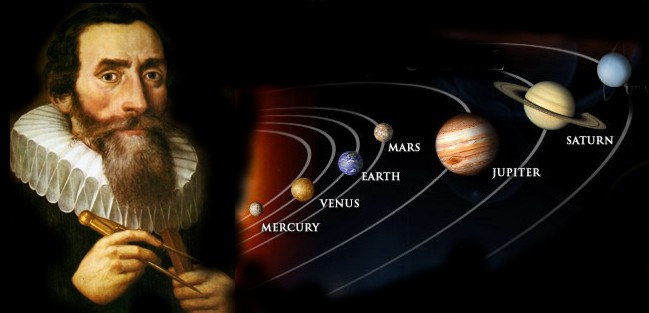
Johannes Kepler (December 27, 1571 – November 15, 1630) was a German mathematician, astronomer and astrologer, and key figure in the 17th century scientific revolution. He is best known for his eponymous laws of planetary motion, codified by later astronomers, based on his works Astronomia nova, Harmonices Mundi, and Epitome of Copernican Astronomy. These works also provided one of the foundations for Isaac Newton's theory of universal gravitation.


What Kepler found during the long years of observation were the so called 3 Laws of Kepler (or the laws of planetary motion). The 3d law can be written:  T^2= (4pi^2a^3 /G(Ms+m), where T is the period of a planet going around the Sun, pi is the famous pi constant, a^3 is the distance to the Sun cubed in this case, G is the gravitational constant (6.67 x 10^-11), Ms is the mass of the sun and m is the mass of the planet. Since m is very small in this case, it is negligible so you can use only Mo in the equation. Rearranging gives Ms= (4pi^2 a^3)/T^2 , where T is 1 year for the planet Earth. Calculations give that Ms = 1.989 x 10^30 kg.

Other important properties of the Sun can also be calculated using similar methods. But it's enough for today.

The most fascinating thing for me is that all of these equations are dead simple, and the fact that by using such simple calculations and principles can help you weigh the Sun. You can truly love maths when the equations are simple and you calculate interesting things. After all, once Galileo said that the language of nature is mathematics. And this language doesn't always have to be hard. Sometimes it's just purely charming.

Thanks for reading!

Tuesday, February 1, 2011

Maths Can Be Fun


So as you might have noticed I've been lately watching a lot of documentaries and lectures about physics, maths and all that stuff. I presented you the Ted Talks channel a while ago, and I still think it's one of the best channels on youtube so feel free to check it out. However, I also found some great docummentaries from BBC a while ago. One if them I would like to share with you. It's called The History of Mathematics.

Now when it comes to maths, I guess I'm like most of you - I don't enjoy spending countless hours solving the same problems and writing everything all over again after making a silly mistake. Yet, at the same time, I realise that there is another side of mathematics. It's like the dark side of the moon, that we never see, yet it's so mysterious and cool. The beauty of maths is all around us, after all, even Galileo once said - maths is the languange of our universe. The ability to use simple equations to understand our universe, calculate amazing things, like distances to stars or mass of the sun using simple techniques that were invented thousands of years ago soung fantastic to me. Unfortunatelly, most of the teachers and school systems simply hide this beautiful side of mathematics under tons of boring homework and bad explanations.

But let's get back to the subject. I found this great documentary, which tells the story of mathematics. It's narated in a very interesting way. Also it shows the more interesting side of mathematics, and how it evolved since the ancient times. I really enjoyed this BBC documentary and I hope you will too. So here's the link (you will find later parts on youtube).

History of Mathematics Part 1


Thanks for reading!


Also check this out if you're interested:


Design by Free WordPress Themes | Bloggerized by Lasantha - Premium Blogger Themes | Lady Gaga, Salman Khan