Showing posts with label learn yourself. Show all posts

Tuesday, July 19, 2011

Free Quantum Mechanics Lectures from Yale University


Quantum mechanics is one of those tricky subjects, which are hard to learn from books alone. It's one of those branches of physics that are best understood when explained by an experienced lecturer. That's why I present you this mini series of lectures by professor Ramamurti Shankar from Yale university.

There 7 lectures in total, which cover most of the main topics of QM starting with double slit experiment and De Broglie wavelength and ending with various postulates of QM.

The lecturer is really good, as he explains all the concepts in an easy to understand way and always keep asking students if they're following. In addition, he always tries to give practical examples of physics concepts, which is great.

Here's the first lecture. The link to other lectures is below the video.


Links to other lectures: Link 1
                                  Link 2

You might be interested in:

Sunday, June 12, 2011

How to Learn Calculus The Simple Way


So I guess it's safe to say that calculus is one of those topics, which are for some reason really hard to grasp for most of the students in high school and later in college. Maybe, it's because calculus is really a unique branch of mathematics, that is, it's different from most of the mathematics that we are taught in high school (most of which was developed by ancient Greeks, of course with some slight improvements by later mathematicians). After all, it was developed by greatly gifted mathematician and scientist Isaac Newton (and Leibniz too).

I myself remember having some problems with calculus. It's not that I didn't grasp the mathematics, it was just most of the time I didn't have the feeling what I was calculating, or what's the sense of derivatives, integrals and so on. And what really helped me, when I was revising before going to college, was some great books and video lectures.

Firstly, I really enjoyed these simple YouTube lectures by Prof. R.Delaware. I like this guy because he really doesn't presuppose that you have some past knowledge about calculus (except of course some basic mathematics from high school), he simply explains everything as it was being explained for the first time.

These lectures cover all the basic high school calculus and some of the basic college calculus. Basically the two main parts are differentiation and integration.

So here's the first lecture:
And you can find all the other lectures on calculus and other topics HERE.

If you're looking for a book specifically that would help you with calculus I highly recommend Calculus for Dummies. It's a very basic and fun to read book, which will give you all the required knowledge of high school and some college calculus. Also it contains very nice diagrams, which give you a great visualisation of calculus concepts. Also it contains some neat tricks how to do calculus problems.


Thanks for reading! If you enjoy my blog feel free to subscribe and comment. Cheers!


Sunday, April 3, 2011

Basics of Quantum Mechanics Lesson 4


So last time we calculated the wave function of a free moving particle and got the following answer:

SE for a free moving particle:
Solution for this equation:  

So what do these equations tell us about the free moving particle? To find the answer to this question we need to find the probability density function. If you recall, the probability density function is basically just the square of an absolute value of the wave function. So by calculating the probability density function we would get:


|Psi |^2 = Psi x complex conjugate of Psi =
= A(cos(kx − wt) + i sin(kx − wt))A(cos(kx − wt) − i sin(kx − wt))
= A^2(cos2(kx − wt) + sin2(kx − wt))
= A^2


Now if you look at the result more carefully, you should realise that there's some strange stuff going on. The probability density function is constant, that means that the probability of finding a the particle in any point of space is equal. In more simple words, you have the same probability of finding the free moving particle in your room and somewhere in the other side of the universe. This is due to the fact that we have not taken into account the uncertainty of the momentum of a particle.


So you might be asking  - why are we studying free moving particles, while in reality most of the matter is situated in confined atoms and molecules. And you're definitely right, so let's look at another system, which might help us understand the behaviour of electrons, which are "trapped" in an orbit of an atom.


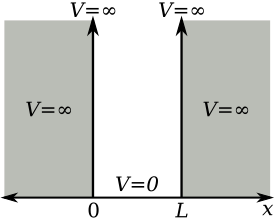
The easiest way of understanding simple atoms or similar systems is using a thing called infinite potential well. That is a system in which a particle is trapped between infinite potential "walls", which can be for instance be various electric of magnetic fields or anything similar, which confines the particle in a given space. After all, in a sense electrons orbiting a nucleus are also in a similar potential well - if they get too close to the nucleus, they are pushed back, if the get too far they are attracted back. 


Infinite potential well:


So how does particle behave in such a well? Well let's firstly imagine what would happen in a classical situation, let's say for a tennis ball trapped between two walls. It's clear that (neglecting gravity, which would eventually bring the ball down) any position between the walls has the same probability of finding the ball there.

However, in quantum mechanics, things are different. We already know that particles tend to behave as probability waves, so it's clear that the probability of finding the particle in any point of space will not be equal( a good analogy of a wave in a sort of potential well is a rope fixed at two places and oscillating).


So how can we find out at which points of space we are most likely to find the particle? By solving the Schrodinger equation of course.

And since this is a basic course we're not gonna bother ourselves with the process of solving the SE. We're just gonna skip right to the solution which is:

Wave function for a particle confined in a infinite potential well: Psi(x) = Asin kx

Now to calculate the probability density function, we need to apply the initial conditions of the system - as we know the particle can't be in points of space, which are beyond the boundaries.

In an infinite potential well the boundary conditions imply:
 Psi (0) = Psi  (L) = 0.
Resulting in the limitation that k must have one of the discrete set of values
kn = (pi . n)/L , where
n = 1, 2, 3 . . .


Now when we know k, we can find allowed energies.
Using  E= (p^2)/m and De Broglies wavelength p= h/ lambda = hk/ 2pi gives the following:

En = (h^2 . n^2)/(8mL^2)
 n = 1, 2, 3 . . .


The allowed energies for the trapped particle are quantised according to the value of
n which is known as a quantum number.


Note that we can calculate the quantum number using simple calculations, which we'll look at later. It's important to notice that for macroscopic objects n is very larger, which gives rise to the so called correspondence principle - the idea that if n is very large (which is definately the case for macroscopic objects), quantum mechanics prediction become similar to classical physics prediction.

And we can see this by finding the probability function of the infinite potential well, and graphing it with different values of n:


As we can see as n grows, the wavelenght of the wave in the graph becomes shorter. In n was very very big, it would look as every point in the confined space has the same probability (like in the classical physics case).


So that's all for now, thanks for reading!


LINK to lesson 3
LINK to lesson 2
LINK to lesson 1
Wednesday, March 9, 2011

Basics of Quantum Mechanics Lesson 3


So last time we looked at the corner stone of Quantum Mechanics - Schrodinger equation:


* Note it's a simplified version for 1 dimension.

This time we're gonna look at some simple solutions of this equation, which will show us how microscopic particles behave.

So let's start by simplifying Schrodinger equation for a case of a free moving particle. Since the zero of potential is an arbitrary choice we choose to make U0 = 0. This gives:
(1)


Also it is useful for our solution to express the energy E in terms of momentum p (where Ek= (mv^2)/2 & p=mv), which gives:


 (2)


Substituting (2) into (1) gives:


This can be simplified further using De Broglie's wavelenght (something we covered last time: p=h/lambda) and defining a quantity called wave number k: k= 2pi/lambda:


( Schrodinger equation for a free moving particle)


So how can we solve this equation? We'll it's not a trivial process, and it doesn't really matter for learning the basics, so let's skip to the answer:


(where A is some constant, e is the exponential function, i is the square root of -1 from complex numbers, k is the wave number)


Note that this is a time-independent solution. The time dependence of the wave function comes from solving the time dependent Schrodinger equation, which gives:

So ok, we solved the SE for a free moving particle and found the wave function, but what does it tell us about the particle? Don't worry we're gonna look at it next time. Thanks for reading!


LINK to lesson 1
LINK to lesson 2

Friday, February 25, 2011

Basics of Quantum Mechanics Lesson 2


Last time we looked at one of the most important principles of the quantum mechanics - Heisenberg uncertainty principle. This time, we're gonna try to understand more about the micro world by analysing one of the most famous experiments - double slit experiment. Also we're gonna find out what a wave function is and how it helps to analyse the micro world.

The idea behind the double slit experiment is dead simple - a wave of light (works also for water & sound) is sent through a screen with two slits. If the size of the slits is correct (has to be comparable with the wave length of the light waves) two parts of the wave interfere with each other, creating an interference pattern on the screen. Diagram below illustrates the setup of the experiment, as well as the real view of the interference pattern in b).


So there's nothing particularly shocking about this. It's not hard to see water waves interfering in everyday life. However, there was a shocking surprise that scientists stumbled upon when using the same experimental setup with particles! But before finding out what this shocking surprise was let's think what would happen if you would try experimenting with this double slit setup while using particles. For the sake of simplicity let's imagine that our particles are like tennis balls. Let's assume you have to hit a wall with a tennis ball through a screen of two big slits. After throwing a dozen or more balls you would observe a pattern similar to this:

Once again - nothing shocking here. So after this "experiment" let's switch to the microscopic world and try the same thing with microscopic particles, let us say electrons. Of course, by using common sense, everyday experience and all your tennis knowledge you might guess that we might get the same pattern. But what we actually get is one of the most shocking discoveries of modern physics:


Yes, we get an interference pattern like in the case of waves. Now, after scratching your head for a while, you might say that this must be because a bunch of electrons interfere like waves while travelling to the screen. This is a perfectly reasonable assumption. So let's test it. Let's try sending a single electron through the slits, that way it won't interfere with anything and using common sense once again it shouldn't form an interference pattern. Hey but quantum mechanics wouldn't be quantum mechanics if that was the case would it? What we actually get is another bizarre thing. If we send electrons one by one, at first no interference pattern is visible, but eventually an interference pattern appears! Now this is really strange, using common sense (well at least in a classical physics point of view) the electron can't go through both slits at the same time and interfere with itself. So something strange has to be going on.

Naturally scientists were also shocked so they decided to find out, which slit the electron goes through. So guess what happen then. Well when they tried to observe the electron, no interference pattern appeared! Now once again this is very strange. It's actually connected to the Heisenberg's uncertainty principle - when you send a photon to collide with an electron (observing the electron) you change it's momentum. But we'll look at that  later.

So what conclusions can we draw from all of this. Well firstly, it is clear that rules of classical physics break down when it comes to the microscopic world. Secondly, particles in the microscopic world seem to have wave-like properties. And finally, due to Heisenberg's uncertainty principle, we can't be totally sure of a position and momentum of a particle. So due to these conclusions it is clear that if there was a theory that described the microscopic particles it had to describe particles with wave-like properties and would have to use Heisenberg's principle. And that theory of course is quantum mechanics. So let's look at two corner stones of quantum mechanics - Schrodinger equation and wave functions.

Now if you remember your high school days (or if you are in high school), you might recall that one equation called Newton's 2nd law was highly important. Almost all of the most important laws and equations in mechanics can be derived from or using the famous equation F=ma. For instance equations of constant acceleration motion ( s(t)=Vot +(-) (at^2)/2) can be derived using Newton's 2nd law. Furthermore simple wave equations can also be derived using the same equation. So natural question would be - is there a way to derive a equation, would tell us where to find a particle at a given time t in quantum mechanics?

The answer is yes! This equation is called the wave function. It is noted with a Greek letter psi. What does the wave function do? The answer is that it helps you to find out how likely it is to find a particle in a given place at a given time (actually it is the probability density function that does this, but the p.d.f is just the squared absolute value of the wave function).
The notation of the wave function (time independent):


An example of a graph showing the p.d.f. of a particle's position. It can be found using the wave function


A lot of quantum mechanics is about finding the wave function for different stuff, for instance the electrons orbiting a nucleus, a particle in a potential well and so on. So how do we find this wave function?? Well like in classical physics it was necessary to solve Newton's 2nd law, it is necessary to solve Schrodinger Equation to find a wave function in quantum mechanics.


The Famous Schrodinger equation (in a simpler, time independent form):

So by solving this equation you can get the wave function. But it's enough for today. Next time we're gonna look at some simple solutions to the wave function and also something called De Broglie's wavelength. Thanks for reading!


You might want to check out this:


Sunday, February 20, 2011

Basics of Quantum Mechanics Lesson 1


So I've been learning quantum mechanics for some time now and I can say that it's a charming subject. It's hard to find another part of physics which makes you panic and adore it at the same time. So that's why I decided to create these simple lessons of the basics of quantum mechanics.

I tried to study quantum mechanics by myself a couple of times in the past and what I found out was that it is really hard to find good lessons, lectures or books about the basics online. I mean you can easily find good e-books about the whole philosophical part of quantum mechanics, which explain the basic principles, but hardly give you the real taste of the subject with whole the maths part of it. On the other hand, you can find a lot of hardcore stuff, like lectures and videos which require you to know the subject at a very high level. So as you can see it's really hard to come up with some real basic quantum mechanics with all the appropriate maths for a beginner. So I decided to make these basic lessons that give you all the basic stuff you need.

So firstly let's look at some basic information about quantum mechanics: Quantum mechanics, also known as quantum physics or quantum theory, is a branch of physics providing a mathematical description of much of the dual particle-like and wave-like behavior and interactions of energy and matter. It departs from classical mechanics primarily at the atomic and subatomic scales, the so-called quantum realm. In advanced topics of quantum mechanics, some of these behaviors are macroscopic and only emerge at very low or very high energies or temperatures. The name, coined by Max Planck, derives from the observation that some physical quantities can be changed only by discrete amounts, or quanta, as multiples of the Planck constant, rather than being capable of varying continuously or by any arbitrary amount. For example, the angular momentum, or more generally the action, of an electron bound into an atom or molecule is quantized. While an unbound electron does not exhibit quantized energy levels, an electron bound in an atomic orbital has quantized values of angular momentum. In the context of quantum mechanics, the wave–particle duality of energy and matter and the uncertainty principle provide a unified view of the behavior of photons, electrons and other atomic-scale objects.


So let's start easily. At the heart of quantum mechanics there is the famous Heisenberg uncertainty principle. This principle appears in all parts of quantum mechanics so it's important to know it by heart and get it out of the way early.

Heisenberg uncertainty principle:      


 So what does this mean? It means that the product of the uncertainty in position of a particle and momentum must always be higher than some constant quantity, which is h bar/2, where h bar= h/2pi (Planck constant). This means, that if you try to detect a particle you can only do it with a certain precision. For instance, if you detect it's position with a very small uncertainty then you will have a very big uncertainty in momentum of the particle. 

Now this is very strange, because we are so used to the "fact" that we know the position of anything very accurately. And now suddenly we realise that when it comes to microscopic world, we can't even find the exact position of the particle. But this is just the beginning of the whole strangeness of the quantum world.

But why can't we detect particles position or moment with a big precision? Well it's mostly because of the way we detect particles. Long story short, we detect a particle by shooting a photon at it (a particle of light). However, a photon also has some momentum and as strange as it sounds you can simply "knock" a particle away with a photon. Also, if you want to find out the position of a particle with a high precision, you must use a high frequency light wave (a high energy photon, where the energy of a photon E is given by E=hf, where h- Planck constant and f- frequency) which naturally has a bigger momentum, which causes a particle to be knocked away at a high velocity. This is exactly what causes the uncertainty in the momentum.


Now if this looks strange to you then don't worry. I mean the whole world was in shock when quantum mechanics was established. One of the most shocking things was the collapse of the Newtonian determinism. This is an idea that if you know enough information about a particle, you can calculate it's position and velocity in the future, that is if you have enough information you can tell the future. You can imagine how shocked the world of science was when after a couple of hundread years suddenly they realised that you can't actually tell the particle's position and momentum with an exact precision (thus you can't tell the future of a particle with an exact precision). Long story short, the world went upside down in the beginning of the XX century - particles became wave - particle probability waves, nothing was certain anymore, electrons decided to show up at two different places at one time, other particles started to travel back in time and so on. Whole hell broke through in the world of science back in those days.  All of these crazy things brought to the world of science by the quantum mechanics can really cause headaches, but hey don't worry, it can be explained in a very elegant way. But we'll look at it next time.Thanks for reading!

PS. I'm not an expert of quantum mechanics, so if you notice any mistakes feel free to tell me. Thanks!


Saturday, January 22, 2011

So You Want to Learn Physics?


So you want to learn physics? Good choice! But can you really learn it if you're bad at maths or too old for for college? The answer is yes.

For more than 3 years I've been studying various subjects of physics on my free time and I found many good books and free lectures. The hardest part about self-studying is finding suitable books and lectures. Most of the time you just simply find books that are too hard or too easy, thus it's important to know good authors and lecturers.

So a couple of months ago I stumbled upon a great video lecture of physics from Yale university. Basically it's a part of a project in which universities from all around the world share video lectures with people on the web. This is a general course on physics - it contains a variety of subjects, such as mechanics, special relativity, waves and other classical stuff. For most of the part, maths is fairly straightforward (as much as maths for physics can get).

So here's the link with the free lectures (there is a variety of other free lectures on this website covering astronomy, economics, chemistry and so on):

Free Yale Courses

Just for a taste - first lecture:


PS. if you find maths during the video lectures overwhelming you can always check out some great books on maths from the For Dummies series. You can find them here:

Maths for Dummies

Thanks for reading!


Sunday, July 18, 2010

So You Want to Learn Physics (The Fun Way)


These days when internet is easily accessible, it's easy to learn anything you like from home. Internet, being the biggest virtual library, gives you an opportunity to learn various science fields as well. Today I will show you some nice books that you can easily find on the internet. These books helped me to learn various subjects an get better at high school.

If you want to learn physics you should start from simple high school level physics, however there are some very nice books, which can teach you the basics of quantum mechanics, string theory, general and special theories of relativity and other.

There's a very nice book about time travel, which covers many aspects of general relativity, special relativity, quantum mechanics and some history of physics. This book is called Black Holes Wormholes and Time Machines by Jim Al-Khalili. It's a simple to read book that contains basically no maths, so it can be read by anyone.


Another great book for those, who want to learn the basics of modern physics is Elegant Universe by Brian Greene. This book also covers the basics of Einstein's theories, quantum mechanics and some history of physics. The main focus of the book is string theory.


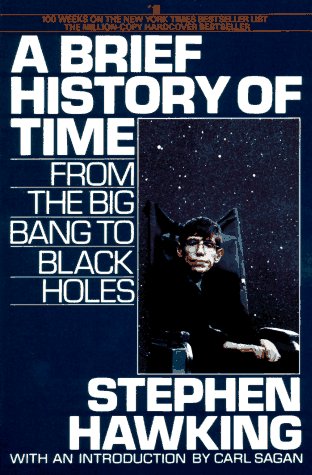
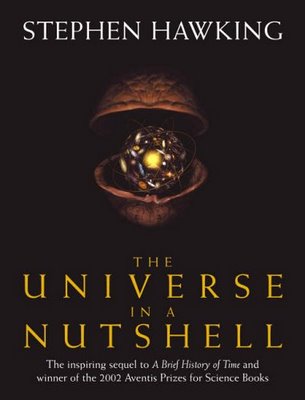
After reading these books, you could find Stephen Hawking's books useful. The most popular of his books are The Brief History of Time and The Universe in a Nutshell.  Both of the books cover a wide range of physics subjects, are easy to read and contain some valuable knowledge.


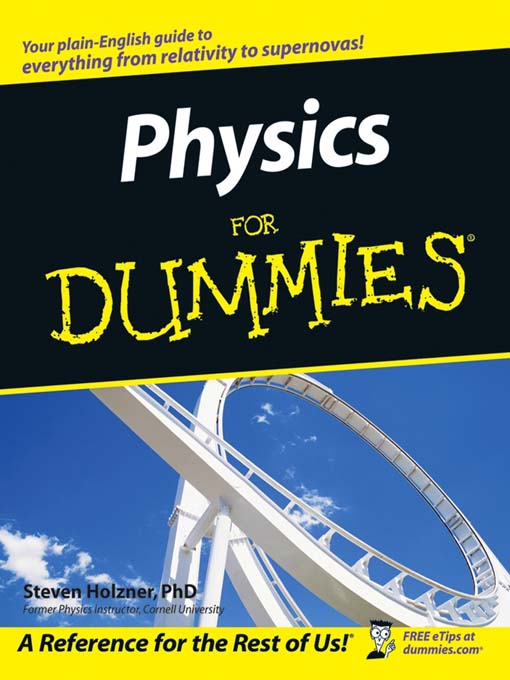
The series of books called For Dummies contain a lot of useful books, basically about anything. You can find many useful books like The String Theory for Dummies, Physics for Dummies and so on.  I highly recommend these books for starters, because they're easy to use and contain all that a starter needs.


Well that's it for now. Thanks for reading. I hope these books, will be useful for you. Please subscribe or follow my blog if you like it.

Sunday, June 20, 2010

Internet - a Powerful Learning Tool


Internet has become a very powerful learning tool. This is an article about various ways of using the internet for learning.

Internet Encyclopedias

If you need to learn something you will need some valuable specific information and internet encyclopedias can help you. Online encyclopedias like Wikipedia, Encyclopedia, Britannica and others are great sources of information. Internet encyclopedias have many advantages compared to classical paper encyclopedias, for instance you can find information much faster. So, all in all, be sure to use online encyclopedias during the learning process.

Ebooks

Internet is like monumental digital library where you can find nearly everything these days. Starting with newspapers ending with philosophical books - everything's online. So in order to learn something you will surely need some books. In order to learn something, for instance particle physics, just look for some online ebooks about the basics of particle physics. The advantage of internet is that most of the times you can find free ebooks so you can save time and money.

Video

In order to learn something well you have to learn it in many different ways. What I want to say is that you have to use all of your senses. By watching various online videos about the subject you're trying to learn, you will not only read the information, but also you will watch and hear it. By using a variety of senses you will enrich your learning process and it'll be easier to remember the learning material.

Audio Ebooks

If you want to enrich your learning experience even more you can download audio books. It's especially useful when you don't have enough time to actually read books.

Power of Forums

Another way of enriching the learning experience is joining a forum of a relevant subject. That way you'll meet new interesting people and will have a chance to discuss your learning material with them.

Thursday, May 6, 2010

So You Want to Find Out How Nuclear Bombs Work?


How to Improve Your Iq Score


Design by Free WordPress Themes | Bloggerized by Lasantha - Premium Blogger Themes | Lady Gaga, Salman Khan