
Showing posts with label articles. Show all posts

Friday, December 2, 2011

Some Explanations for Crazy Neutrinos


So as you all know neutrinos have been behaving in a rather bizarre way these days. And even though thousands of headlines already declared Einstein's theories wrong, in reality more independent tests are needed to confirm the results. So meanwhile let's check out some possible explanations for this strange behaviour of neutrinos.

This pictures illustrates how the experiments were done:


Source

Perhaps the most famous explanation is that neutrinos might be travel some of the way in another dimension, which enables them to complete the journey faster. This short cut scenario would explain the strange results without challenging relativity. Perhaps the simplest analogy would be travelling between two points on the surface of Earth through a tunnel instead of travelling on the surface. The main problem however is that extra dimensions still belong to the more exotic theories of physics. That is there is no direct proof of any extra dimensions yet. Also, if neutrinos could do something as fancy as extra dimensional travel we should have detected it when observing massive supernova explosions, which enable quite accurate predictions of the speed of neutrinos. However, no such faster than light travel was ever detected.

Of course there are scientists who think that neutrinos have indeed travelled faster than light. However, according to physicist Sheldon Glashow, if neutrinos were indeed travelling faster than light in vacuum, they would radiate electron-positron pairs and would simply lose energy. This change in energy would be noticeable in the OPERA experiment, however no energy loss was detected. So this means that there simply is some kind of systematic error or that something really bizarre is going on.

So the other possible explanation might be some kind of unknown factor, which messes up the experiment and gives faster than light results. After the famous results were published, scientists were flooded by emails asking whether they included rotation of the Earth, general relativity, continental drift and other similar factors to their calculations. So far it seems that everything was included, as even the second experiment gave positive results that neutrinos travelled faster than they should. Yet, one of the newest explanations says that the anomaly in the speed of the particles could be explained having in mind that satellites were used to accurately determine the distance between Cern and Gran Sasso. And since the satellites where moving relatively to the observers on Earth, the calculations should be slightly different, which could give a change in the results of about 64 ns., which is very close to the result found in the experiments.

So even though there are many great as well as crazy explanations all of them have to be examined and checked. It will take long and hard work to test all of this, but as history shows, every great revolution in science starts with a crisis.

Also some guys sent me this crazy video. It's a song about neutrinos and it's so cheeeeeeesy. Actually, it's one of the strangest songs I've seen, but check it out :D


Saturday, October 22, 2011

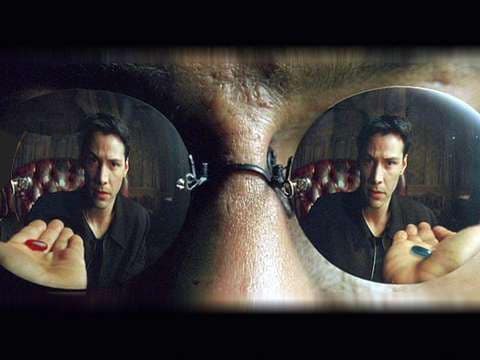
Simulated Reality Theory


So let me ask you something. How many times have you woken up in a cold sweat after a terrible nightmare? I'm sure that you've had this unpleasant experience at least a few times. But how about waking up after the sweetest dream just to realise the sad truth  that it's not a dream? I bet it happened to you many times as well. But why am I asking you this? Simply because dreams can help us understand how easy it is to get tricked by something that is not real. After all, some dreams seem so realistic that sometimes you forget which events happened in reality and which you've dreamed off.

So if dreams are so realistic how can we really know if we are not dreaming now? Or even better how can we know that we are not living in a simulated reality, like the matrix or even a video game? As stupid as it sounds, these theories are gaining some momentum in the world of philosophy and science these days. And when you really think about it, there seem to be no simple arguments against these theories. After all, illusions can seem as realistic as reality is. So let's look a little closer at the idea of a simulated reality.

Rene Descartes:
Source

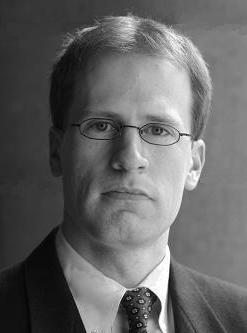
As we've seen in the last article, the idea that reality might be an illusion was popularized by the famous work of Rene Descartes called Meditations on First Philosophy. The modern version of a similar argument that reality is just a computer simulation was proposed by Swedish philosopher  Nick Bostrom in 2003. The simple version of Bostrom's argument goes as follows:


i) It is possible that an advanced civilization could create a computer simulation which contains individuals with artificial intelligence.
ii) Such a civilization would likely run many, billions for example, of these simulations (just for fun, for research and other similar reasons).
iii) A simulated individual inside the simulation wouldn’t necessarily know that it is inside a simulation.

Then the ultimate question is — if one accepts that the above premises are at least possible — which of the following is more likely?

a. We are the one civilization which develops AI simulations and happens not to be in one itself?
b. We are one of the many (billions) of simulations that has run?

In greater detail, his argument attempts to prove the trichotomy, either that:

i) Intelligent races will never reach a level of technology where they can run simulations of reality so detailed they can be mistaken for reality (assuming that this is possible in principle);
ii) Races who do reach such a sophisticated level do not tend to run such simulations;
iii) We are almost certainly living in such a simulation.

Nick Bostrom:
Source

This argument goes beyond scepticism, (i.e. we cannot be sure if reality is not an illusion) and claims that the odds are that we are actually living in a virtual reality. What's even more interesting that some philosophers believe that eventually beings in a such a simulation would become so advanced that they would create their own simulations, so we could be living somewhere in this web of simulations. But let's forget these crazy ideas for a while and let's imagine that we are indeed living in an advance computer simulation created by some advanced alien race or humans of the future. Would it be possible to somehow detect that our reality is just a simulation?


If you had a choice to find out whether our reality is real, would you choose to know?

Source

Perhaps science hides the answer to this question. Physicist Richard Feynman once said that physics is like sitting in a corner of a huge chess board. Once in a while you see some chess figures moving in a specific way, but you can't see the whole board. So you observe the movement of the figures until you understand how every figure moves. So maybe we are like these lone observers on a huge chess board, which we call the universe. By studying the laws of the universe we are moving closer to understanding the real meaning of it. That's exactly why some scientists believe that if we had the so called theory of everything, which would describe all the laws of the universe in one equation, we could find the meaning of the universe and possibly understand its purpose and we might even find some clues about the architects of the virtual reality that we call our universe.

Another clue about the non-reality of our world would be the so called bugs or system errors of the simulation. These bugs would probably appear as physical anomalies, which we couldn't explain, and would probably occur very rarely. On the other hand, one might argue that a sufficiently powerful simulation would monitor the thoughts of the inhabitants of the virtual reality and delete their memories after the discovery of a bug. Another possibility is that these bugs are a part of our reality, for example some physical anomalies or even some events in our everyday life were never supposed to happen, but they were left in the simulation as deleting them would cause suspicion 

Another possibility is that there might be so called Easter eggs (secret messages left by the designers). For example there are many enthusiastic mathematicians who are looking for clues and hidden messages in the numbers of natural constants like pi. The problem with this idea is that it depends on an assumption that the creators want us to find out about the fact that we are living in a simulated reality. Nevertheless, the idea of Easter eggs sounds amazing. It would be a great scenario for a sci-fi movie.

Nick Bostrom about his ideas:


There are many ideas regarding the processing power of the computers that supposedly simulated our reality. Assuming they don't have infinite processing power, we can conclude that there could be a limit to the processing power, which would materialize similarly to pixels in video games that we create. Old video games made for low processing power computers look grainy as you can see every pixel. Whereas modern computers with high processing power make it hard to distinguish between thousands of pixels. Similarly, we could find similar phenomena in the microscopic world. There are scientists who actually think that Heisenberg uncertainty principle is evidence for the limit of processing power of the computers, which simulate our reality.

These are all very interesting ideas, but is it, at least in theory, possible to check them? It seems that the only chance we have is to observe the laws of physics and look for some clues, which would indicate that our universe is just a simulation. Of course one might say that the designers could create our reality in such a way that it wouldn't be possible to detect that it's a simulation from the inside. Still there are actually scientists, who believe that there are some similarities between the laws of the universe and the computer software codes. But, whether it's just another crazy idea or it's actually just crazy enough to be true, nobody knows. Well, only time will tell.

Sunday, September 11, 2011

So What's Going on at LHC Lately?


So how is the great hunt for the Higg's particle going on in the biggest particle smasher in the world?

Unfortunately, Higgs chasers haven't found the great particle yet, however the collected data indicates a tighter range of possible masses of the hypothetical particle. To fit into standard model of particles Higg's boson has to be lighter than 145 billion electron volts.

Despite this, Higg's particle is still playing hard to get. There were signs of Higgs back in July, when scientists found some particles, which indicated that there might exist a lighter Higgs particle which is really hard to find at low energies.

The good news is that LHC physicist still expect they will either find the Higgs particle or rule out the existence of the famous particle in 2 years. Let's hope this is exactly what's going to happen, after all, it's about time for the good old Peter Higgs to get his Nobel Prize.

Source

Wednesday, September 7, 2011

Top 10 Greatest Physics Experiments: 5. Torsion Bar Experiment


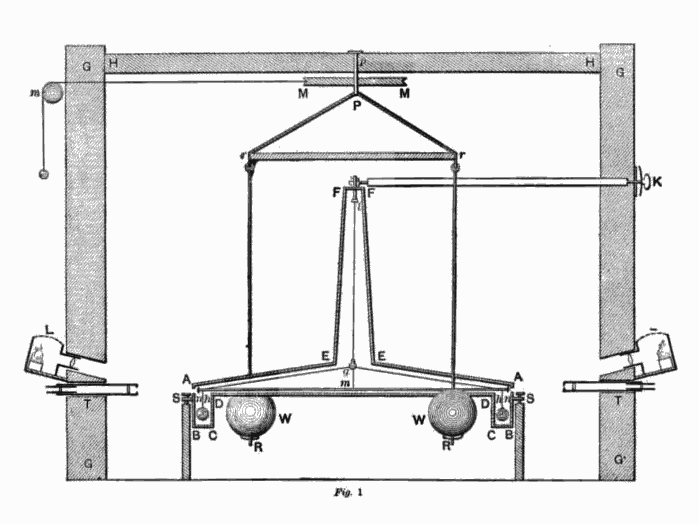
The experiment was performed in 1797–98 by the English scientist Henry Cavendish. He followed a method prescribed and used apparatus built by his countryman, the geologist John Michell, who had died in 1793.
Even though Newton already had calculated the value of the gravitational constant G, it wasn’t confirmed in labarotory. This is where the torsion bar experiment comes into play.

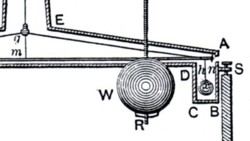
The apparatus employed a torsion balance, essentially a stretched wire supporting spherical weights. Attraction between pairs of weights caused the wire to twist slightly, which allowed the first calculation of the value of the gravitational constant G. The experiment was popularly known as weighing the Earth because determination of G permitted calculation of the Earth's mass. The simple equation of gravity created back at the end of 17 century by Newton was confirmed once again.

Source

Source


Thanks for reading! Please subscribe and comment. Cheers!

Monday, August 29, 2011

Wonders of Mathematics: Game of Life


Game of Life or simply Life is a mathematical game (cellular automaton) created by John Conway in 1970.

Conway created the game because he was interested in a problem presented in the 1940s by mathematician John von Neumann, who attempted to find a hypothetical machine that could build copies of itself and succeeded when he found a mathematical model for such a machine with very complicated rules on a rectangular grid. The Game of Life emerged as Conway's successful attempt to drastically simplify von Neumann's ideas.

It's interesting that the game is called "Life" as scientists also believe that life on our planet started and developed from very primitive and simple organisms.

So how do you play this game? The idea is simple - you choose a number of blocks (cells) and arrange them in a chosen way. Then you can just start the program and see how the system evolves. Cells evolve according to these rules:


1) Any live cell with fewer than two live neighbours dies, as if caused by under-population.
2) Any live cell with two or three live neighbours lives on to the next generation.
3) Any live cell with more than three live neighbours dies, as if by overcrowding.
4) Any dead cell with exactly three live neighbours becomes a live cell, as if by reproduction.


 Different initial configurations can create amazing results, for example:

Source

So if you want to try this game you can find it in the given links:
Link 1
Link 2 (this one's quite cool as it is in 3D)

Thanks for reading!

Saturday, August 27, 2011

Top 10 Greatest Physics Experiments: 6. Newton's Prism


In number 6 we have another giant of physics – Isaac Newton. Newton is famous for his theories on dynamics of moving bodies, invention of calculus and the law of gravitation. However, not many people know that Newton also did many important experiments while investigating the properties of light.

Even though light is not completely understood even today, back in the 17th century, people actually new quite a lot. Ever since the times of Aristotle it was believed that light had some kind of a purest form (or colour), which somehow get’s altered to form other colours. It was believed that rainbows were somehow formed using this principle.

Newton decided to test this prediction by shining a ray of white light through a glass prism. And the result of this is one of the most beautiful experiments in the history of physics.

So what really happens is that white light, which is made up of all the main colours (Red, Orange, Yellow, Green, Blue, Indigo, and Violet) when going through the prism, splits up in the mentioned colours, all leaving the prism at different angles. This is due to the fact that light changes speed when entering a different medium like glass. This depends on a thing called the refractive index of a material, which is different for different colours and different materials. Thus all the colours that make up white light refract at different angles, which is exactly what causes a rainbow pattern to appear.  


Thanks for reading. If you like my stuff please subscribe, follow and comment. Cheers

Wednesday, August 10, 2011

Top 10 Greatest Physics Experiments: 7. Foucault's Pendulum


 There were ideas that the Earth might be rotating around its axis since the days of Nicolaus Copernicus (1473 - 1543). However, even though it was a rational idea, backed up by great arguments in the works of Copernicus, it wasn’t experimentally proven. Thus many people in the middle ages and later epochs weren’t aware of the fact that our planet is rotating around its axis. After all, it’s really hard to believe such a thing, as we can’t feel the Earth’s rotation.

It was Jean Foucault (1819 - 1868) a brilliant French physicist, who finally proved Earth’s rotation experimentally, more than 300 years after the works of Copernicus. Foucault built a 28 kg brass-coated lead bob with a 67 meter long wire from the dome of the Panthéon, Paris, which basically worked as a huge pendulum. The idea of the experiment is very simple – as the pendulum swings, it’s clear that Earth rotates, due to the movement of the ground below the pendulum (which, to us looks like the movement of the plane of the pendulum, as we rotate with together with Earth).


This simple, yet very hard to construct, experiment, finally proved that Earth really rotates. Furthermore, it proved the rotation of our planet in a very simple way, so that even simple people, who knew nothing about science, could easily be convinced. That is why this experiment is one of the most important experiments throughout history.

Thanks for reading! If you like my stuff feel free to comment, follow and subscribe.

You might be interested in:


Friday, August 5, 2011

Top 10 Greatest Physics Experiments: 8. Measurement of the Earth's Circumference by Eratosthenes


Here we have another experiment, which enhanced our knowledge about Earth. However, this experiment is very unique, as it was carried out more than 2000 years ago. 

As the title says it, this experiment was set up to measure the circumference of Earth. Eratosthenes, a Greek mathematician and the librarian of the great library at Alexandria, in Egypt came up with a brilliant idea how to geometrically calculate the circumference of Earth using shadows in two different cities.

Eratosthenes knew that in Syene (a city almost due south of Alexandria) the sun was directly overhead at noon on a particular day of the year. This meant that at noon a yardstick wouldn’t cast a shadow. Also he knew that Sun is so far away that light rays coming from it would basically be parallel. Thus light rays at the same time in Alexandria should cast a shadow (see the diagram)


Now since Eratosthenes knew that the angle between the vertical and the shadow is equal to the central angle inside the circle (diagram). He also knew that there is 360 degrees in a circle. Thus all he needed to calculate Earth’s circumference was the distance between Alexandria and Syene.


To understand this more clearly let’s look at an example. Let us say the central angle is 7.2 degrees. This is an angle between Alexandria and Syene. Thus if we divide 360 by 7.2 we get 50. This means that Earth’s circumference is 50 longer than the distance between the two cities.

So all that Eratosthenes needed to do is pay for someone to measure the distance between the two cities. In case you’re wondering how correct was Eratosthenes, depending on the units that he used, he was somewhere between 1% and 16% off, which is amazing having in mind that the experience took place 2000 years ago. 

Thanks for reading! Please comment, follow and subscribe. Cheers

You might be interested in:

Friday, July 22, 2011

Science: Lost Between Yin and Yang


If you're reading this, than you must be sitting in your favourite chair or perhaps using your laptop while lying on your favourite couch. Also, you must be having your fancy smartphone by your side and perhaps one of those cool LCD TV's. Let's be honest, all this sophisticated technology makes our lives great and comfortable. For the first time in history, we can communicate to the other side of the globe with ease, fly to other continents and even fly to the outer space. For all of this we have to be thankful to science. But does science have a darker side?

Source

Lately I've been reading these articles about how evil science can be. It really got me thinking. And it's really true that science can be used to create terrible things. Actually, the stereotype of a mad evil scientist has been around for years. Ever since Dr. Jekyll turned into Hyde and the terrible Frankenstein monster was created, science has had a darker side in the media.

Of course science has been used for terrible things in reality too. After all, science can be used to create terrible weapons of mass destruction, which can kill thousands and even millions. Even today many scientists refuse to work on nuclear weapons, as they believe it is morally wrong.

So does science bring more evil or more good to our world? I think science is only a tool, which can be used for both and evil. I mean nuclear physics, which has brought terrible weapons of mass destruction,but it has also brought us nuclear power plants. Countless of such examples can be found, as science can truly be used for good and bad.

So what do you think about this? Does science bring more good or evil to the world?


Wednesday, July 20, 2011

So How do We Know that Earth Really Rotates?


Everyone knows that Earth rotates around its axis. But have you ever wondered is there some kind of simple proof of this? The answer is yes. The famous experiment performed by Jean Foucault proved the rotation of Earth. But let's start at the beginning.

There were ideas that the Earth might be rotating around its axis since the days of Nicolaus Copernicus (1473 - 1543). However, even though it was a rational idea, backed up by great arguments in the works of Copernicus, it wasn’t experimentally proven. Thus many people in the middle ages and later epochs weren’t aware of the fact that our planet is rotating around its axis. After all, it’s really hard to believe such a thing, as we can’t feel the Earth’s rotation.

Foucalt's Pendulum in Paris:

Source

It was Jean Foucault (1819 - 1868) a brilliant French physicist, who finally proved Earth’s rotation experimentally, more than 300 years after the works of Copernicus. Foucault built a 28 kg brass-coated lead bob with a 67 meter long wire from the dome of the Panthéon, Paris, which basically worked as a huge pendulum. The idea of the experiment is very simple – as the pendulum swings, it’s clear that Earth rotates, due to the movement of the ground below the pendulum (which, to us looks like the movement of the plane of the pendulum, as we rotate with together with Earth).

This simple, yet very hard to construct, experiment, finally proved that Earth really rotates. Furthermore, it proved the rotation of our planet in a very simple way, so that even simple people, who knew nothing about science, could easily be convinced. That is why this experiment is one of the most important experiments throughout history.


Thanks for reading! If you like my stuff feel free to follow and subscribe. Updates are added daily.

Wednesday, July 13, 2011

Strangest Facts of Physics: Most of the Universe is Missing


Isaac Newton, inspired by the falling apple in his yard during the Great Plague, created his greatest work – the law of gravity. This wonderful and simple law predicted the movements of planets, stars and even galaxies.  Even though, Newton’s calculations could precisely predict movement of any stellar object, the great genius had no idea how gravity actually worked.


More than 3 centuries later perhaps the greatest physicists ever, Albert Einstein, created his famous special and general theories of relativity. Even though Newton's law of gravity was very precise, there were some cases when movement of the planets and galaxies could bot be explained by this simple law. However, Einstein's general relativity combined with Newton's laws could explained almost all the movements of the planets, stars and galaxies. The great thing about these theories is that they can be used to find out more about the universe. For example by observing the rotation of the outer stars in the galaxy, scientists could calculate the total mass of the galaxy.
This is where the whole  strangeness started. When calculating, the mass of various galaxies scientists realised that those galaxies move in such a way as if there was more mass in them than we can observe. This meant that either there was something wrong with current theories and calculations or there was some invisible matter, which interacted only gravitationally. And since Einstein's theories have been tested and proved dozens of times, scientists came to the conclusion that there is some kind of strange invisible matter called dark matter. This is our strange fact of today. 


Even more shocking is that there is almost 6 times more dark matter than ordinary matter in our universe. This means, that even now, there's invisible dark matter in your room, which cannot be seen or detected in any way, except gravitationally. 


What the universe is made of:


Source 


Thanks for reading! Please subscribe and comment.

Saturday, February 26, 2011

History of the Universe Part 3


So I wrote another edition to the series "History of the Universe". If you're interested, you can check it out here: History of the Universe Part 3. Thanks!

Tuesday, February 8, 2011

Weighing the Sun


We all know how easily you can find the basic facts about the Sun on the internet these days. But have you ever wondered how did scientists come up with these numbers? It has to be some kind of a hard scientific process you might think. But you'd be surprised how easy it can be.

Ancient Greeks were famous not only for their unique culture, which has influence on the world of today but also for their mathematical achievements. Almost all of the ancient Greek philosophers had an interest in mathematics, physics, logic and other important subjects. So it's natural that Greeks left some important innovations in mathematics for the future civilizations. Most of the ancient Greek ideas are still in use even today. But why am I talking about the ancient Greek Scholars? Because of the famous innovation of the Greeks - The Pythagorean Theorem (there are some evidence that earlier civilisations had a grasp of calculating the sides of the right triangle but for the sake of an argument let's just call it the Pythagorean Theorem), which can be used to deduce the distances not only to the sun but even to distant stars.

What is even more amazing is that you can calculate the distance to the Sun even without the knowledge of the Pythagorean Theorem. One of the easiest and accurate ways is using a radar to calculate the distance to Venus and then deducing the distance to the Sun. Why not use a radar to detect the distance to the Sun you might ask. Well the problem is that Sun is not very good at reflecting things. So below we have a picture, which illustrates the simple situation, which is used to calculate the distance to the sun.


 The idea is simple - you use a radar to find the time it takes for a signal to travel and reflect from Venus at two different times of the year. Using a simple equation s=v x t, gives t1= 2(R-Rv)/c and t2= 2(R+Rv)/c, where c is the speed of the radar signal (which is of course the speed of light c~ 3 x 10^8 m/s).

Now you simply add the two equations and find that Rv's simplify out and then you can easily calculate R:

t1+t2= [2(R-Rv)+2(R+Rv)]/c = 4R/c, which gives R: R=1 Au= 1.5 x 10^8 km

Of course this is not the only available method. You can also use the simple ideas of ancient Greeks who were very good at calculating triangles. For instance using a triangle you can find the distance to the sun, and using the Pythagorean theorem you can calculate the radius of the sun.


As we can see from the sketch, distance a can be found using simple trigonometry. Since we can use a radar to find the distance to Venus (Rv), we find that it is: Rv = a cos(e). We can easily find the angle e by observation from Earth. Which means that a = Rv/cos(e). Dead simple.

Radius of the Sun can be calculated using simple 5th grader level maths - Pythagorean theorem.
Which gives Rs=(a^2- Rv^2)^0.5 (square rooth).


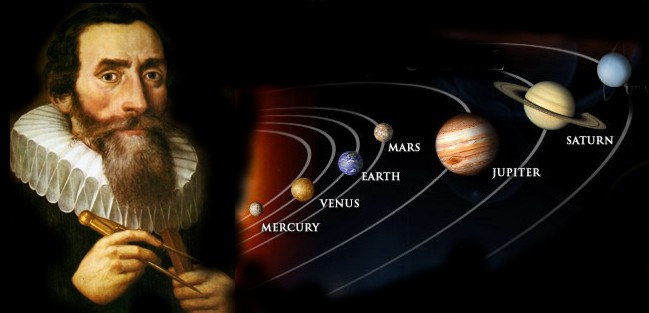
Finally you can easily calculate mass of the Sun using what is known as the Kepler's 3d Law.
Johannes Kepler (December 27, 1571 – November 15, 1630) was a German mathematician, astronomer and astrologer, and key figure in the 17th century scientific revolution. He is best known for his eponymous laws of planetary motion, codified by later astronomers, based on his works Astronomia nova, Harmonices Mundi, and Epitome of Copernican Astronomy. These works also provided one of the foundations for Isaac Newton's theory of universal gravitation.


What Kepler found during the long years of observation were the so called 3 Laws of Kepler (or the laws of planetary motion). The 3d law can be written:  T^2= (4pi^2a^3 /G(Ms+m), where T is the period of a planet going around the Sun, pi is the famous pi constant, a^3 is the distance to the Sun cubed in this case, G is the gravitational constant (6.67 x 10^-11), Ms is the mass of the sun and m is the mass of the planet. Since m is very small in this case, it is negligible so you can use only Mo in the equation. Rearranging gives Ms= (4pi^2 a^3)/T^2 , where T is 1 year for the planet Earth. Calculations give that Ms = 1.989 x 10^30 kg.

Other important properties of the Sun can also be calculated using similar methods. But it's enough for today.

The most fascinating thing for me is that all of these equations are dead simple, and the fact that by using such simple calculations and principles can help you weigh the Sun. You can truly love maths when the equations are simple and you calculate interesting things. After all, once Galileo said that the language of nature is mathematics. And this language doesn't always have to be hard. Sometimes it's just purely charming.

Thanks for reading!

Saturday, February 5, 2011

Voyager Golden Records - The Face of Humankind


When the famous Voyager I and Voyager II spacecraft were being created, the creators decided to add records containing a message to any extraterrestrial intelligence that might find them in the future. The real dilemma, interestingly was not how to create a record but what to include in it. What might be the message that would describe our beautiful planet and the humankind itself?

What was created were the famous Voyage Golden Records. The Voyager Golden Records are phonograph records which were included aboard both Voyager spacecraft, which were launched in 1977. They contain sounds and images selected to portray the diversity of life and culture on Earth, and are intended for any intelligent extraterrestrial life form, or for future humans, who may find them.  But what exactly was included in the ultimate message by the humankind to the far reaches of outer space?

The contents of the record were selected for NASA by a committee chaired by Carl Sagan of Cornell University. Dr. Sagan and his associates assembled 116 images and a variety of natural sounds, such as those made by surf, wind, and thunder, and animal sounds, including the songs of birds and whales. I addition, a variety of music of various genres and eras was added. Finally, greetings in 55 languages were added.

The most amazing thing about the Voyager Golden Records for me is the message that they deliver. Just try to imagine some strange alien race or the humans of the far future discovering these golden records, which were lost for thousands of years in the deep reaches of space. I truly believe that they would be amazed of the beautiful sounds of classical music, as well as the amazing views of the nature of Earth. They would be astounded by the creativeness and good will of the human voices which greet them.

Of course, there's a darker side of humankind. For thousands of years people have been killing one another in bloody wars. For most of the last century people have been poisoning our precious planet and destroying nature in almost all possible ways. But when I think about it for a while I truly believe that even though humankind is not perfect, we have one amazing feature - no matter what happens humans never give up and make things better. And maybe if we remembered more often how wonderful and creative humankind can be, the world would be a better place. 

Thanks for reading! I also added some videos with information about the Voyager records. And finally here's some music and images from the Golden Voyager Records:


Thanks for reading!


You might be interested in:


Tuesday, February 1, 2011

Maths Can Be Fun


So as you might have noticed I've been lately watching a lot of documentaries and lectures about physics, maths and all that stuff. I presented you the Ted Talks channel a while ago, and I still think it's one of the best channels on youtube so feel free to check it out. However, I also found some great docummentaries from BBC a while ago. One if them I would like to share with you. It's called The History of Mathematics.

Now when it comes to maths, I guess I'm like most of you - I don't enjoy spending countless hours solving the same problems and writing everything all over again after making a silly mistake. Yet, at the same time, I realise that there is another side of mathematics. It's like the dark side of the moon, that we never see, yet it's so mysterious and cool. The beauty of maths is all around us, after all, even Galileo once said - maths is the languange of our universe. The ability to use simple equations to understand our universe, calculate amazing things, like distances to stars or mass of the sun using simple techniques that were invented thousands of years ago soung fantastic to me. Unfortunatelly, most of the teachers and school systems simply hide this beautiful side of mathematics under tons of boring homework and bad explanations.

But let's get back to the subject. I found this great documentary, which tells the story of mathematics. It's narated in a very interesting way. Also it shows the more interesting side of mathematics, and how it evolved since the ancient times. I really enjoyed this BBC documentary and I hope you will too. So here's the link (you will find later parts on youtube).

History of Mathematics Part 1


Thanks for reading!


Also check this out if you're interested:


Saturday, January 29, 2011

I Introduce You The Great "Ted Talks"


So lately I've been watching a lot of Ted Talks on YouTube and boy are they good. The idea behind this is that various experts from a variety of fields discuss important issues, science, psychology, management and other important stuff.

Basically it's a series of lectures, which are presented by professionals, who really know how to catch your attention. Among them there are some great science lectures, starting with astronomy ending with particle physics. So enough of this rambling, check out their YouTube channel here:

Ted Talks

Friday, January 14, 2011

Mind Blowing Facts About Nuclear Bombs + Chernobyl Disaster


While surfing around the web I found many interesting stories and urban myths about science. One of them is about a blind girl who sees a flash on an atom bomb.

A Blind Girl Sees a Flash of an Atomic Bomb

The first story is about an atomic bomb. As the story goes, during a testing of an atomic bomb in 1945 a blind Mexican girl saw the explosion. The interesting part about this story is that it's true. Now, it's quite clear that there are many ways to feel an atomic explosion without actually seeing it in some way. Thus it's not clear how the girl felt the explosion. Still it's an amazing story.


Now I like this story, because it's about atom bombs. I mean there are many subjects, which both scare and fascinate people these days. Ghosts, evil spirits, ufos and other paranormal phenomena - all of these subjects are always popular in the modern myths and legends. However, there is another group of subjects, which are even more fascinating. It's the real stuff. And by that I mean serial killers, unexplained scientific phenomena, terrorist attacks, nuclear explosions and so on. All of these things are even scarier, because they might just happen to you...

Atom bombs fascinated people ever since the first tests and explosions at Hiroshima and Nagasaki in 1945. After all, what can be more fascinating and horrifying at the same time than the most deadliest weapon, which can kill thousands in a matter of seconds. Thus I dug up some interesting facts about nuclear bombs and explosions. Enjoy!


1. There are still some 26,000 nuclear warheads in the world, enough to destroy civilization many times

over and destroy most life on earth. Nuclear weapons make humans an endangered species.

2. More than 95% of all nuclear weapons are in the arsenals of the US and Russia.

3. The average nuclear weapon in the US arsenal is approximately eight times more powerful than the
nuclear bomb that destroyed Hiroshima, immediately killing some 90,000 people.

4. There are currently nine countries with nuclear weapons (US, Russia, UK, France, China, Israel, India,

Pakistan and North Korea).

5) In the aftermath of the Cold War, a variety of

new nuclear threats have emerged. Among these are the following dangers:

• Increased chances of nuclear weapons falling into the hands of terrorists willing to use them;

• Policies of the US government to make nuclear weapons smaller and more usable;

• Use of nuclear weapons by accident, particularly because of decaying Russian infrastructure; and

• Spread of nuclear weapons to other states that may perceive them to be an “equalizer” against a more
powerful state.

6) The cost of US nuclear weapons research,

development, testing, deployment and maintenance has exceeded $7.5 trillion.

7) Cost of the Manhattan Project (through August 1945): $20,000,000,000


8) In ten minutes, a hurricane releases more energy than all the world's nuclear weapons combined!


9) Belarus received 70% of the contamination from Chernobyl.

Neighboring regions are often hit hardest in the event of a nuclear disaster, and that’s been especially true in the case of Belarus. Located just 10 miles away from the Chernobyl Nuclear Power Plant, scientists estimate that this landlocked country was hit by 70% of the radioactive outburst.

10) Nuclear rain from the Chernobyl disaster fell as far away as Ireland.

11) Chernobyl disaster remains the only Level 7 incident on the International Nuclear Event Scale. That is, it's the biggest man-made disaster in human history.


You might be interested in:


Tuesday, January 11, 2011

Real Ghost Hunters and So Much More...


When it comes to paranormal phenomena, most of the scientists are sceptical right from the start, that is why I was amazed to find out that there is such a thing as a Society for Psychical Research.


Society for Psychical Research is a non-profit UK based organization seeking to understand and explain paranormal phenomena in a scientific manner. The SPR was founded in 1882 in London by a group of eminent thinkers including Edmund Gurney, Frederic William Henry Myers, William Fletcher Barrett, Henry Sidgwick, and Edmund Dawson Rogers. Initially six committees were established in order to research Thought-Transference, Mesmerism and similar phenomena, Mediumship, Reichenbach Phenomena (Odic Force), Apparitions and Haunted Houses, physical phenomena associated with séances, and the Literary Committee which studied the history of these phenomena.


 Today the society is run by a president and a council of twenty members. The organization is based at 49 Marloes Road, Kensington, London, with a library and office open to members. Also the society publishes quarterly Journal of the Society for Psychical Research (JSPR), the irregular Proceedings and the magazine Paranormal Review.

The greatest thing about this organization is that it is open for public. By paying for the membership you get access to the libraries, subscription to the Journal of The Society and invitations to the meetings of the society.

I also happen to find a Journal of the society, which was really interesting to read. Here's the link:

Journal of the Society for Psychical Research

Website of the Society for Psychical Research

Thanks for reading!

Monday, September 27, 2010

Top 10 Mysteries of Cosmology


Cosmology is one of the most important branches of physics, however it also has many unanswered questions and mysteries. This article lists the top 10 mysteries of cosmology.


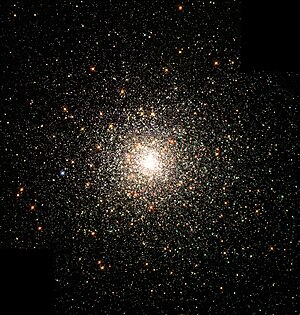
10) When were the first stars formed. What were they like and how they looked? Today we know quite a lot about the history of the universe. According to the big bang theory, the universe started about 13.7 billion years ago. About 3 seconds after the Big Bang, nucleosynthesis set in with protons and neutrons beginning to form the nuclei of simple elements, however it took about 100 000 years for the atoms to form the ordinary matter, which can be found in our universe these days. Later, due to gravitation, various stars formed. We know a lot about star evolution today, however it’s still not clear when were the first stars formed. Hopefully new telescopes will be invented and we will find out even more.

Source


9) Why are the galaxies distributed in clumps and filaments? Sounds very simple, but we still don’t know the answer to this question.

Source


8 ) Why is there an almost empty area of space next to the centre of our galaxy?Scientists believe that in the centre of the Milky Way Galaxy there is a massive black hole. All the stars in our galaxy seem to be orbiting this super massive black hole. However, there also seems to be an empty area of space close to the centre of our galaxy, which according to current scientific knowledge is very strange. According to theory, the black hole at the centre of the universe should eventually attract many stars closer to the centre of milky way. However, observations show that it is not the case. Hopefully new telescopes will shed some light on the problem.


7) Do Black Holes really exist? Everybody knows what a Black Hole is, however, scientists have never observed one directly. It is possible to guess that every galaxy has a Black Hole in the centre of it by various gravitational effects, however it is much more harder to detect a Black Hole directly, because it doesn’t radiate light. Let’s hope in the near future scientists will observe the so called Hawking’s radiation (according to Hawking Black Holes do radiate energy, although very slowly) and he will win his Nobel price.

Source


6) Is it possible to create a quantum gravity theory. The two great theories of the 20th century do a great job when it comes to describing the world of the big (universe, galaxies and so on) and the world of the small (subatomic particles). I am of course talking about the general theory of relativity and the quantum mechanics. According to astrophysicists the first moment of the universe – the big bang started from a singularity. To find out how exactly the universe started it is necessary to join these to big theories, because at the star of the universe all the matter was formed in a microscopic singularity, which had extraordinary strong gravitational properties.


5) How exactly gravity works? Many of the great minds throughout the history tried to answer this question. Newton formulated the law of gravitation, which easily enables to calculate the movement of heavinly bodies to a great degree of accuracy. However, Newton had no idea how that magnificentinvisible force worked. Einstein came up with the famous general theory of relativity, which explained that gravity was the result of the deformation of time and space. Still, there are many questions, like is the space time physically detectable, are gravitons real, do gravitational waves really exist and so on. Many modern experiments are being carried out, which aim to solve some of these problems, however it may take many more years or even another great mind like Newton and Einstein to totally conquer the mystery of gravity.

Source


4) Why is there an arrow of time? Is it possible to turn it around? Most of the laws of physics work great independent of the direction of time, time seems to be running from the past to the future. But why exactly does time only go to one direction? Why is the future different from the past? Also, is it possible to travel back in time?


3) What is Dark Matter? By observing the movement of the galaxies and planets it is possible to find out how much mass is in the various galaxies. Interestingly, the observation show that there’s actually less visible matter in observed galaxies than the theory suggest. This invisible matter is called the Dark Matter.


2) What is Dark Energy? Almost everyone knows that the universe is expanding, even more interesting is that the universe is not only expanding, but also it’s expansion is accelerating. Thus scientists believe that there is some kind of an invisible energy, which is spread throughout all the universe. This energy, which is called Dark Energy, is the cause of the acceleration of the expansion of the universe. However, no one has an idea what exactly it is.

Source


1) What happened before the big bang? Some believe that it was god, who caused the beginning of the universe, others believe in quantum fluctuations, others think our universe was a part of another universe in a multiverse and so on… To be honest, nobody knows what exactly happened before the big bang. It is the ultimate secret of both cosmology and physics. Will we ever find out the answer to this question? Only time will tell.

Monday, August 30, 2010

The Mysterious Dark Energy


Design by Free WordPress Themes | Bloggerized by Lasantha - Premium Blogger Themes | Lady Gaga, Salman Khan