Showing posts with label wonders of mathematics. Show all posts

Monday, August 29, 2011

Wonders of Mathematics: Game of Life


Game of Life or simply Life is a mathematical game (cellular automaton) created by John Conway in 1970.

Conway created the game because he was interested in a problem presented in the 1940s by mathematician John von Neumann, who attempted to find a hypothetical machine that could build copies of itself and succeeded when he found a mathematical model for such a machine with very complicated rules on a rectangular grid. The Game of Life emerged as Conway's successful attempt to drastically simplify von Neumann's ideas.

It's interesting that the game is called "Life" as scientists also believe that life on our planet started and developed from very primitive and simple organisms.

So how do you play this game? The idea is simple - you choose a number of blocks (cells) and arrange them in a chosen way. Then you can just start the program and see how the system evolves. Cells evolve according to these rules:


1) Any live cell with fewer than two live neighbours dies, as if caused by under-population.
2) Any live cell with two or three live neighbours lives on to the next generation.
3) Any live cell with more than three live neighbours dies, as if by overcrowding.
4) Any dead cell with exactly three live neighbours becomes a live cell, as if by reproduction.


 Different initial configurations can create amazing results, for example:

Source

So if you want to try this game you can find it in the given links:
Link 1
Link 2 (this one's quite cool as it is in 3D)

Thanks for reading!

Friday, July 15, 2011

Wonders of Mathematics: Complex Numbers


Everyone, who came across complex numbers in mathematics knows how strange they are. But do these numbers really exist? Are they important?

First let's look at what complex numbers are. More than 2 thousand years ago, ancient Greeks believed that every number can be expressed as a fraction, for example 1/2, 2/5 and so on. However, they were shocked, when they realised that a hypotenuse of a right triangle with sides of length 1 cannot be expressed using natural numbers or fractions. As we all know, the length of the hypotenuse of such a triangle is a square root of 2 (which is 1.414...). This showed ancient Greeks that there is more than a single number system, in this case it's the real number system (which includes counting numbers as 1, 2...., negative numbers, fractions, square roots and so on).

Source

Until complex numbers were found and were used in mathematics, it was thought that all the number systems were already found. So what is a complex number? It's easy. It's a number that is a square root of a negative number.

But do such numbers have any physical meaning? After all, even when calculating simple quadratic equations, younger students are told to ignore negative answers, as negative areas do not exist. Surely such negative areas might not exist, but complex numbers constantly show up in various applications, which shows that even though we can't visualise a square root of -1, it still exists in mysterious ways.

The strange thing about complex numbers in fact is that they almost seem to be existing and not existing at the same time. For example, when solving differential equations, in electrical engineering (also in many other fields), the behaviour of electrical circuits depends on whether the solutions are real or complex numbers.

Another example is quantum mechanics. The wave function, that describes behaviour of microscopic particles is found using complex numbers. That is something real and physical is described by laws which use complex numbers.

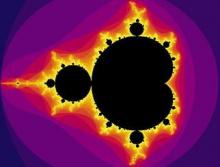
The so called Mandelbrot Set shows a set of complex numbers generated by a simple equation:

Source

Some physics theories even use complex number plane to represent time, whereas real numbers represent spatial dimensions.

But the real question is whether complex numbers represent something physical. When it comes to square roots of positive numbers, we can clearly visualise what they mean. For example, if we know an area of a rectangle is 16 meters, we can take the square root of this number and find out that the side of the rectangle is 4 meters. But when it comes to complex numbers, a similar situation cannot be found.

Monday, May 2, 2011

3x3 Magic Square


Last time we looked at magic squares in general and found out that the most simple magic square is of order 3x3.

There is beautiful legend about the discovery of this popular magic square.

As the story goes, in ancient China there was a huge deluge: the people offered sacrifices to the god of one of the flooding rivers, the Lo river (洛水), to try to calm his anger. A magical turtle emerged from the water with the curious and decidedly unnatural (for a turtle shell) Lo Shu pattern on its shell, which contained the numbers in an aray of a magic square. As the legend says, these numbers showed the people how often and how many sacrificies should be given to calm the Lo river.

The Lo Shu square containing the numbers on the turtle's back:


So what are these magic numbers?

It appears that all magic squares obey some rules. For instance all normal magic squares of un-even order (of  n x n order, where n = 3,5,7...) have a special number at the centre called the magic constant.

So for a 3x3 magic square you have 1+2+3+4+5+6+7+8+9=45. In a magic square you have to add 3 numbers again and again. Therefore the average sum of three numbers is 45:3=15. The number 15 is called the magic number of the 3x3 square.
You can also achieve 15, if you add the middle number 5 three times.  You can reduce 15 in a sum of three sums eight times: 15= 1+5+9;  15= 2+4+9;  15= 2+6+7;  15= 3+5+7


15=1+6+8;  15=2+5+8;  15=3+4+8 ; 15=4+5+6

The odd numbers 1,3,7, and 9 occur twice in the reductions, the even numbers 2,4,6,8 three times and the number 5 four times. Therefore you have to place number 5 in the middle of the magic 3x3 square.

The remaining odd numbers have to be in the middles of a side and the even numbers at the corners. 

*The formula to find other magic constants is:

M= [n(n^2 +1)]/2

So by using the information above we can see that there exists only 1 magic 3x3 square (of numbers 1-9). Of course you can rotate the magic square in total of 8 ways, which gives all the possible distributions of the numbers in a 3x3 magic square.

Thanks for reading!

Friday, April 29, 2011

Wonders Of Mathematics - Magic Squares


So one of the books that I really enjoyed recently is the famous Dan Brown's "The Lost Symbol". If you read the book (and you should) you might have noticed that it has many interesting maths references. One of which is hidden in the famous Albrecht Dürer's 1514 engraving Melencolia. It's a very special magic square.

But what are these magic squares? Magic squares are very interesting square arrangements of numbers. The numbers are arranged in such a way, that the sum of all columns, rows and diagonals is equal to the same number.

Magic squares come in different sizes that are called orders, for instance 3x3, 4x4 and so on (it's just a number of rows and columns). As for the sum that is constant for columns, rows and diagonals it's called the magic constant.

 
Image Source

The most simple magic square is of order 3x3 (it's easy to see that 2x2 squares are not possible). But how do you construct such a magic square, without relying to guess work? There are various rules, which can help you construct the square faster, however some guess work is still essential.

So when stumbled across these magic squares, I decide it would be fun to found a 3x3 magic square without any help. It's quite fun, well at least much more fun than sudoku, so I encourage you to try it.

Thanks for reading. Next time we're gonna look at all possible 3x3 magic squares and at the mysterious Melancolia engraving.

 
Design by Free WordPress Themes | Bloggerized by Lasantha - Premium Blogger Themes | Lady Gaga, Salman Khan